

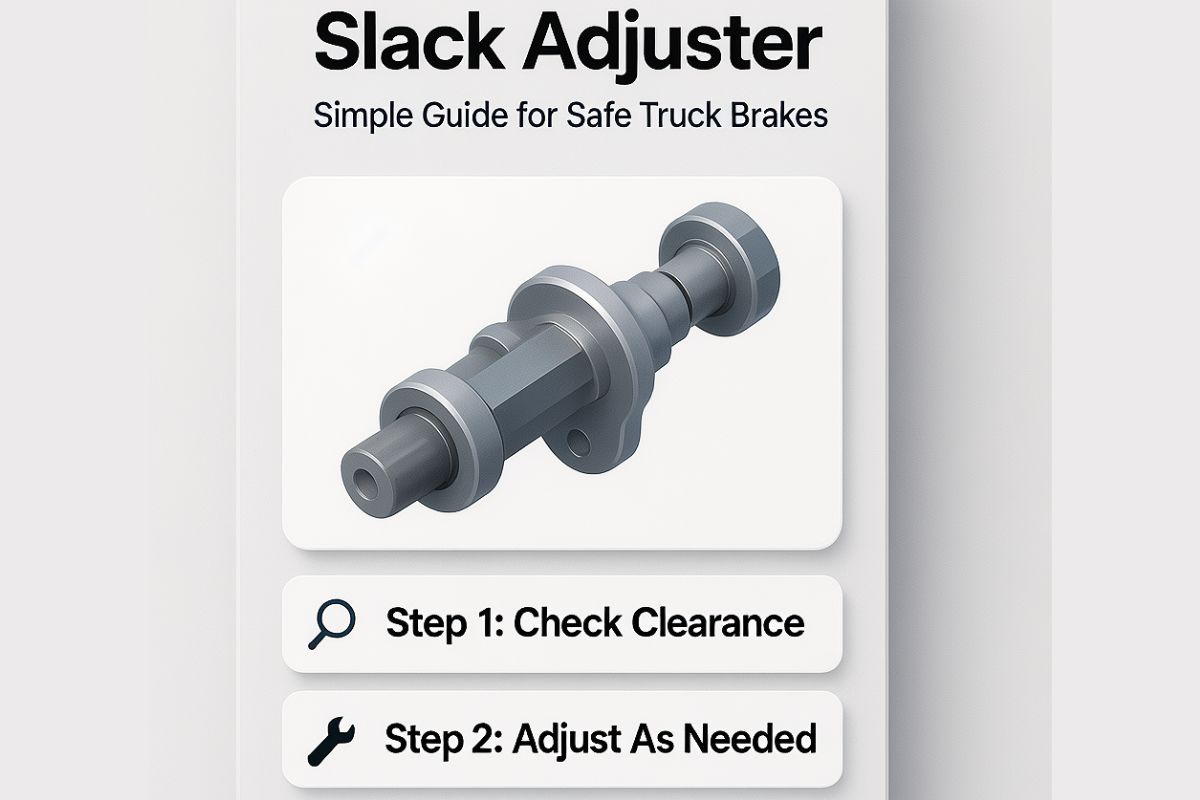
A slack adjuster is the lever on an S-cam air brake that sets the gap between the brake shoes and drum. Automatic types self-adjust as pads wear; manual types need periodic adjustment.
What Is a Slack Adjuster?
The slack adjuster is one of the most important components in a truck’s air brake system. It sits between the brake chamber pushrod and the S-cam shaft, converting the linear motion of the pushrod into rotational force that spreads the brake shoes against the drum. Without a properly functioning slack adjuster, your brakes won’t apply with the right force, leading to longer stopping distances or even brake failure.
Where It Sits in the Air Brake System
The slack adjuster mounts directly onto the S-cam shaft using a splined connection. When you press the brake pedal, compressed air enters the brake chamber and pushes the pushrod forward. That pushrod connects to the slack adjuster’s clevis pin, which then rotates the S-cam. The S-cam’s lobes push the brake shoes outward against the inside of the brake drum, creating friction that slows your wheel.
PEOPLE ALSO READ : How Do Insurance Companies Manage Car Rental Projects
What It Does (Keeping the Brake Gap Right)
As brake linings wear down over thousands of miles, the gap between the shoes and drum grows. The slack adjuster’s job is to maintain the correct clearance so the brakes engage quickly and fully. If the gap becomes too large, the pushrod has to travel farther before the shoes contact the drum. This excessive pushrod stroke reduces braking power and can push the system out of legal limits.
Parts You Can See (Arm, Clevis, Spline)
When you look at a slack adjuster, you’ll notice three main visible parts. The arm is the lever that extends from the S-cam shaft to the clevis pin; its length (measured from the center of the S-cam to the center of the clevis pin hole) determines mechanical advantage. The clevis is the forked fitting at the end of the arm where the pushrod attaches via a pin. The spline is the internal teeth that lock the adjuster onto the S-cam shaft spline count (10 or 28 teeth) must match your axle.

Manual vs Automatic Slack Adjusters
Understanding the difference between manual and automatic slack adjusters helps you maintain your brakes properly and stay legal on the road.
How Each Type Works
Manual slack adjusters require you (or a mechanic) to physically turn an adjustment bolt to compensate for brake lining wear. You typically adjust them during scheduled maintenance or when you notice the pushrod stroke exceeds limits. The adjustment process involves backing off the adjuster until the shoes drag on the drum, then backing it off slightly to set the proper clearance.
Automatic slack adjusters (ASAs) use an internal mechanism usually a worm gear or clutch system that senses pushrod movement and makes small adjustments each time you apply the brakes. Over the course of normal driving, the ASA compensates for lining wear without any manual intervention. Modern trucks built after the mid-1990s almost universally use automatic slack adjusters because they reduce maintenance errors and improve safety.
Pros and Cons (Safety and Upkeep)
| Type | Pros | Cons | Best For |
|---|---|---|---|
| Manual slack adjuster | Low cost; simple design; works without internal mechanism | Needs frequent manual adjustment; higher risk of out-of-adjustment if neglected | Older units, budget fleets with strict PM schedules |
| Automatic slack adjuster (ASA) | Self-adjusts; safer when maintained properly; standard on modern trucks | Can mask other issues (worn cams/clevis); requires proper installation and periodic checks | Most modern trucks, safety-focused fleets |
While automatic slack adjusters reduce day-to-day maintenance, they’re not “set and forget.” You still need to inspect them regularly. A malfunctioning ASA can disguise worn brake components or installation errors, so don’t skip your pre-trip checks.
Quick 60-Second Check (No Tools)
Many drivers perform a simple parking brake test during their pre-trip inspection. With the truck parked on level ground and wheels chocked, release the parking brake and build air pressure to 90-100 psi. Have a helper apply the service brake pedal fully while you watch the slack adjuster arm. The arm should move less than one inch from its resting position. If it travels more, or if you can easily move the arm by hand when the brakes are released, your adjustment may be out of spec.
When the Check Helps and When It Doesn’t
This quick visual check catches gross problems like a completely loose adjuster or broken clevis pin. However, it won’t tell you the exact pushrod stroke measurement, which is what matters for legal compliance. Many out-of-adjustment brakes still look fine during a casual glance. For roadside inspections or thorough maintenance, you need to measure actual pushrod stroke with a ruler or caliper.
How to Measure Pushrod Stroke (Step-By-Step)
Measuring pushrod stroke is the only way to confirm your brakes meet legal limits. This procedure takes about five minutes per wheel once you know the process.
Safety First (Chock Wheels, PPE)
Before you start, park on level ground and set the parking brake. Place wheel chocks in front of and behind at least one wheel on each axle you’re not inspecting. Release the parking brake for the axle you’re measuring so you can apply the service brake. Wear safety glasses and gloves brake dust can irritate eyes and skin, and you’ll be working near moving parts.
Tools You Need
You only need a few simple tools: a ruler or tape measure (ideally a brake stroke gauge or caliper marked in sixteenths of an inch), a piece of chalk or marker to mark the pushrod, and an assistant to apply the brake pedal. Some techs use a digital caliper for extra precision, but a standard ruler works fine.
Steps to Measure and Record Stroke
- Park on level ground and chock wheels on the axles you’re not inspecting.
- Release the parking brake for the axle being measured and build air pressure to 90-100 psi.
- Mark the pushrod at a fixed reference point (such as the face of the brake chamber) with chalk.
- Have a helper fully apply the service brake pedal (90-100 psi application) and hold it.
- Measure pushrod travel from the released position to the applied position. The distance between your chalk mark and the chamber face is the stroke.
- Record the measurement and repeat for each wheel on the axle.
Compare to Legal Limits
Once you have your measurements, compare them to the maximum stroke allowed for your specific brake chamber type. Chambers are marked with a tag or stamp indicating their type (for example, Type 20, Type 24, Type 30 long-stroke). If your measured stroke exceeds the limit for that chamber, the brake is out of adjustment and must be serviced before the vehicle is legal to operate.
Legal Limits by Country
Brake stroke limits vary slightly by jurisdiction, but the underlying principle is the same: excessive stroke means dangerously weak braking. Always verify the specific regulations in your region and check your brake chamber’s data plate for its rated maximum stroke.
USA (FMCSA/CVSA)
In the United States, the Federal Motor Carrier Safety Administration (FMCSA) sets brake regulations under 49 CFR Part 393. The Commercial Vehicle Safety Alliance (CVSA) provides detailed out-of-service criteria used during roadside inspections. As a general reference:
- Type 20 (standard): approximately 1.75 inches maximum stroke
- Type 24 (standard): approximately 2.0 inches maximum stroke
- Type 30 (long-stroke): approximately 2.5 inches maximum stroke
Note: Always confirm your exact chamber type and specification from the chamber tag or manufacturer documentation. CVSA inspectors measure stroke during Level I inspections, and any brake exceeding the limit will place your vehicle out of service.
Canada (NSC/Transport Canada)
Canada follows National Safety Code (NSC) Standard 10, which closely mirrors U.S. Federal regulations. Transport Canada requires that air brake systems maintain proper adjustment, and provincial inspectors use similar stroke limits to those in the CVSA handbook. Most Canadian provinces require annual or semi-annual safety inspections where brake stroke is measured and documented.
UK (DVSA)
The Driver and Vehicle Standards Agency (DVSA) in the United Kingdom enforces brake standards during annual tests and roadside checks. UK commercial vehicles must comply with European ECE R13 brake regulations (despite Brexit, many standards remain harmonized). Inspectors measure brake performance and pushrod stroke; excessive stroke is a major defect that results in an immediate prohibition notice.
Australia (NHVR/Austroads)
Australia’s National Heavy Vehicle Regulator (NHVR) and state-level authorities enforce brake standards based on Australian Design Rules (ADRs) and Austroads guidelines. Maximum pushrod stroke values are similar to North American standards but must be verified against the specific chamber manufacturer’s specifications. Roadworthy inspections include brake stroke measurement, and out-of-adjustment brakes will fail inspection.
Germany (TÜV/ECE R13)
Germany and the broader European Union follow ECE R13 brake regulations under UNECE standards. TÜV (Technischer Überwachungsverein) and other inspection agencies conduct regular vehicle checks. European trucks typically use metric measurements, so stroke limits are expressed in millimeters. Like other regions, exceeding the manufacturer’s specified stroke results in an inspection failure.
Sizing & Buying Guide
Choosing the correct slack adjuster replacement means matching several key specifications. Installing the wrong part can lead to poor brake performance or even damage your S-cam.
Arm Length (5.5″, 6″, 6.5″)
Arm length is measured from the center of the S-cam spline to the center of the clevis pin hole. Common lengths include 5.5 inches, 6 inches, and 6.5 inches. Using an incorrect length changes the mechanical advantage and alters how much the S-cam rotates for a given pushrod stroke. Always replace with the same length specified by your axle manufacturer longer or shorter arms won’t provide proper braking torque.
Spline Count (10 vs 28)
Slack adjusters come with either 10-spline or 28-spline (fine spline) connections. The spline count must match your S-cam shaft. A 10-spline adjuster will not fit a 28-spline cam, and forcing it will damage both parts. Check your old adjuster or consult your axle’s parts manual before ordering.
Left-Hand vs Right-Hand; Offset vs Straight
Slack adjusters are handed left-hand for the driver’s side, right-hand for the passenger side because the clevis must point toward the brake chamber. Some designs are offset (the clevis pin hole is angled away from the S-cam centerline) while others are straight. Offset adjusters provide clearance in tight installations. Verify your axle’s requirements; using the wrong hand or offset can cause interference with suspension components or prevent proper installation.
Brand Notes and Cross-Reference Basics
Major manufacturers include Bendix, Meritor (formerly Rockwell), Haldex, and Gunite. Each brand has its own part numbering system, but aftermarket suppliers often provide cross-reference charts. When buying, confirm the part matches your chamber size, arm length, spline count, and hand. OEM parts usually offer the best fit and reliability, but quality aftermarket options exist if you verify compatibility carefully.
Maintenance & Troubleshooting
Proper slack adjuster maintenance extends brake life and keeps you legal. Even automatic adjusters need periodic attention.
Lube Points and Intervals
Slack adjusters have grease fittings (zerks) at the clevis pin and sometimes at the S-cam spline. Lubricate these points every 25,000 miles or per your maintenance schedule. Use a high-quality bearing grease and avoid over-greasing, which can attract dirt and contaminate the brake chamber. Wipe away excess grease after lubing. Keeping the clevis pin lubricated prevents binding and ensures the adjuster can move freely as the pushrod extends and retracts.
Common Issues and Quick Fixes
Brakes dragging after adjustment: Over-adjustment or a binding clevis can cause the shoes to rub continuously. Back off the adjuster slightly and check that the clevis pin rotates smoothly. Replace worn clevis pins or bushings.
Excessive pushrod stroke: If stroke suddenly increases, check for worn brake linings, a malfunctioning automatic adjuster, or loose mounting hardware. An ASA that isn’t clicking during brake applications may have internal failure.
Slack adjuster spins freely on S-cam: The spline is stripped or the locking hardware has failed. Replace the adjuster immediately this is a dangerous condition that can cause total brake failure.
Uneven brake wear: Mismatched slack adjuster lengths or incorrect adjustment on one side of an axle leads to uneven shoe contact. Verify all adjusters on an axle are the same length and properly adjusted.
When to Replace the Adjuster
Replace any slack adjuster that shows visible wear on the spline, clevis, or arm. Automatic slack adjusters should be replaced if they fail to self-adjust over several brake applications (test by manually pulling the pushrod and listening for the internal mechanism to click). Bent arms, cracked castings, or damaged threads also warrant immediate replacement. Most fleets replace automatic slack adjusters preventively every three to five years or per manufacturer recommendations.
PEOPLE ALSO READ : Complete Guide to Exterior Soundproofing: Transform Your Home into a Peaceful Haven
FAQs
What does a slack adjuster do?
The slack adjuster converts the linear motion of the brake chamber pushrod into rotational force on the S-cam, spreading the brake shoes against the drum. It also maintains the correct clearance between shoes and drum as linings wear.
How do I tell if I have a manual or automatic slack adjuster?
Automatic slack adjusters have a sealed housing covering an internal adjusting mechanism, often with a visible adjustment knob that should not be routinely turned. Manual adjusters have a simple external bolt or worm gear that you turn by hand. Check your axle’s parts manual or look for an “ASA” or “Automatic” stamp on the adjuster body.
How often should I check brake stroke?
Perform a visual slack adjuster check during every pre-trip inspection. Measure actual pushrod stroke at least every 3,000 miles or during scheduled maintenance, and always after replacing brake linings.
What is a safe pushrod stroke for my brake chamber?
Consult the data plate on your brake chamber. Common limits are around 1.75 inches for Type 20, 2.0 inches for Type 24, and 2.5 inches for Type 30 long-stroke chambers. Never exceed the manufacturer’s specified maximum.
Can I adjust an automatic slack adjuster?
You should not manually adjust an automatic slack adjuster during routine maintenance. If an ASA is out of adjustment, it indicates a problem worn linings, a faulty adjuster mechanism, or incorrect installation. Diagnose and fix the root cause rather than manually adjusting.
Why do my brakes drag after adjustment?
Over-adjustment or a binding clevis pin can cause continuous shoe contact with the drum. Back off the adjuster slightly and lubricate the clevis pin. If dragging persists, check for worn components or improper installation.
What size slack adjuster do I need (arm length, spline)?
Match your original equipment. Measure arm length from S-cam center to clevis pin center, confirm spline count (10 or 28), and identify whether you need left- or right-hand and offset or straight configuration.
How do I know left-hand vs right-hand slack adjuster?
Left-hand adjusters mount on the driver’s side; right-hand mount on the passenger side. The clevis must point toward the brake chamber, so hand orientation is critical for proper installation.
What happens if a slack adjuster fails?
A failed slack adjuster can cause complete brake failure on that wheel. Warning signs include excessive pushrod stroke, free-spinning adjuster on the S-cam, or brakes that don’t apply. Replace faulty adjusters immediately.
Are brake stroke limits the same in USA, UK, Canada, Australia, Germany?
The limits are similar because they’re based on chamber manufacturer specs, but each country has its own regulations and measurement standards. Always verify local requirements and your specific chamber’s rated maximum stroke.
When should I replace a slack adjuster?
Replace any adjuster with visible damage (stripped spline, cracked body, bent arm), any automatic adjuster that fails to self-adjust, or any adjuster that’s been in service beyond the manufacturer’s recommended lifespan (typically three to five years for ASAs).
What are common signs of a worn clevis pin or S-cam?
Look for excessive play at the clevis pin connection (the pushrod moves side-to-side), scoring or pitting on the clevis pin surface, or irregular brake application. Worn S-cam lobes cause uneven shoe contact and reduced braking force.
READ MORE : Super Converters