


“Celgene risk management” refers to safety programs for certain Celgene/BMS medicines like Revlimid, Pomalyst, and Thalomid to reduce the risk of severe birth defects. In the US, this is the FDA’s REMS. In other regions, similar rules exist under RMP/PPP. Patients, prescribers, and pharmacies must follow specific steps.
What “Celgene Risk Management” Means Today
When you hear “Celgene risk management,” it describes special safety programs that protect patients taking powerful cancer medicines. Celgene, now part of Bristol Myers Squibb (BMS), makes drugs that work well against certain blood cancers. However, these medicines can cause serious birth defects if a pregnant person takes them or if someone becomes pregnant while using them.
That’s why the FDA and other health agencies around the world created strict rules. Everyone involved patients, doctors, and pharmacies must follow careful steps before anyone can receive these medications.
PEOPLE ALSO READ : Top Healthcare SaaS Guide Benefits & Solutions
Drugs Covered and Why Safety Is Strict
Three main medicines fall under Celgene risk management programs:
- Revlimid (lenalidomide) – treats multiple myeloma and other blood cancers
- Pomalyst (pomalidomide) – treats multiple myeloma after other treatments
- Thalomid (thalidomide) – treats multiple myeloma and certain skin conditions
These drugs are similar to thalidomide, a medicine that caused thousands of birth defects in the 1950s and 1960s. Modern versions work better and have stricter safety rules, but the risk of birth defects remains very high. Even a single dose during pregnancy can cause severe harm to an unborn baby.
Quick Definition of REMS (US) and RMP/PPP (Global)
In the United States, the safety program is called REMS (Risk Evaluation and Mitigation Strategy). The FDA requires this for drugs with serious risks.
Outside the US, similar programs exist:
- RMP (Risk Management Plan) in Europe
- PPP (Pregnancy Prevention Programme) in the UK, Australia, and Canada
All these programs share the same goal: prevent pregnancy exposure and make sure patients understand the risks.
3 Checklists You Can Use Now
Patient Checklist (Tests, Birth Control, Surveys, Refills)
✅ Before starting treatment:
- Complete counseling session with your doctor
- Sign consent forms showing you understand the risks
- Take a pregnancy test (if you can become pregnant)
- Start using two forms of birth control (if required)
- Register in the REMS program
✅ Before each refill:
- Complete required pregnancy test (every 4 weeks for most patients)
- Fill out monthly survey (online or by phone)
- Confirm you’re still using birth control
- Get your authorization number from your doctor
- Pick up medicine within 7 days of the prescription date
✅ While taking the medicine:
- Never share pills with anyone else
- Don’t donate blood, sperm, or eggs
- Tell your doctor about any side effects
- Keep all follow-up appointments
Prescriber Checklist (Training, Forms, Counseling)
✅ One-time setup:
- Complete REMS certification training (online)
- Register in the prescriber portal
- Set up staff access if needed
✅ For each patient:
- Provide thorough counseling on risks
- Review contraception requirements
- Have patient sign consent forms
- Order required pregnancy tests
- Document everything in medical records
✅ Before writing each prescription:
- Verify negative pregnancy test results
- Confirm patient completed monthly survey
- Check contraception compliance
- Obtain and record authorization number
- Write prescription with authorization number
Pharmacy Checklist (Certification, Verification, Dispense Steps)
✅ One-time setup:
- Complete pharmacy certification training
- Register in the REMS pharmacy portal
- Train all dispensing staff
✅ For each prescription:
- Verify pharmacy received the prescription
- Check authorization number is valid
- Confirm prescription date is within 7 days
- Call doctor if information is missing
- Document verification in pharmacy system
✅ When dispensing:
- Provide medication guide to patient
- Remind patient about safe handling
- Tell patient not to share medication
- Remind patient about blood donation restrictions
- Dispense only the amount authorized
How to Enroll and Stay Compliant
Where to Register (Official Portals)
Each medicine has its own REMS website:
- Revlimid: revlimidrems.com
- Pomalyst: pomalystrems.com
- Thalomid: thalomidrems.com
Your doctor and pharmacy register first. Then your doctor enrolls you as a patient. You’ll receive login information to complete surveys and view your records.
Step-by-Step: Get an Authorization Number
Enrollment to Dispensing Flowchart:
1. PRESCRIBER CERTIFIES
↓
2. PHARMACY CERTIFIES
↓
3. PATIENT COUNSELING + CONSENT FORMS
↓
4. BASELINE PREGNANCY TEST (if applicable)
↓
5. PATIENT COMPLETES FIRST SURVEY
↓
6. AUTHORIZATION NUMBER ISSUED
↓
7. PRESCRIPTION WRITTEN WITH AUTH NUMBER
↓
8. PHARMACY VERIFIES NUMBER
↓
9. PATIENT PICKS UP WITHIN 7 DAYS
↓
10. MONTHLY CYCLE REPEATS (test → survey → refill)
The authorization number proves all safety steps were completed. Without it, the pharmacy cannot give you your medicine.
Testing Timeline and Survey Schedule
Month-by-Month Example:
Week 1 (Start of treatment):
- Day 1: Pregnancy test at doctor’s office
- Day 2: Doctor counseling and consent forms
- Day 3: Complete first survey online
- Day 4: Get authorization number and prescription
- Day 5: Pick up medicine at pharmacy
Week 4-5 (Before first refill):
- Week 4: Pregnancy test at doctor’s office
- Complete monthly survey (within 7 days before refill)
- Doctor issues new authorization number
- Pick up refill within 7 days
Every 4 weeks after: Repeat the Week 4-5 cycle.
If you can become pregnant, you need pregnancy tests:
- Before starting treatment
- Every 4 weeks during treatment
- 4 weeks after stopping treatment
All patients complete surveys monthly to confirm they understand the safety rules.
Rules by Medicine
| Drug | Who Must Enroll | Key Safety Actions |
| Revlimid (lenalidomide) | Patients, prescribers, pharmacies | Monthly pregnancy tests, 2 forms contraception, monthly surveys, no blood/sperm/egg donation |
| Pomalyst (pomalidomide) | Patients, prescribers, pharmacies | Monthly pregnancy tests, 2 forms contraception, monthly surveys, no blood/sperm/egg donation |
| Thalomid (thalidomide) | Patients, prescribers, pharmacies (STEPS program) | Monthly pregnancy tests, 2 forms contraception, weekly surveys for first month, no blood/sperm/egg donation |
Revlimid (Lenalidomide): Key Do’s and Don’ts
DO:
- Take exactly as prescribed
- Use two reliable forms of birth control at the same time
- Complete pregnancy tests on schedule
- Finish monthly surveys on time
- Store pills in original bottle
- Return unused medicine to pharmacy
DON’T:
- Skip or delay pregnancy tests
- Share pills with anyone (even family with the same condition)
- Donate blood while taking Revlimid and for 4 weeks after stopping
- Break or open capsules
- Handle capsules if you’re pregnant
- Stop taking suddenly without talking to your doctor
PEOPLE ALSO READ : Grow a Garden Calculator: Plan Space, Dates, Plants, and Yield
Pomalyst (Pomalidomide): Key Do’s and Don’ts
DO:
- Follow the same pregnancy prevention rules as Revlimid
- Take on an empty stomach (2 hours before or after food)
- Tell your doctor about blood clots or circulation problems
- Report any chest pain or trouble breathing immediately
- Keep all follow-up appointments for blood tests
DON’T:
- Take with food (absorption changes)
- Donate sperm while taking Pomalyst and for 4 weeks after
- Miss monthly surveys (your refill will be blocked)
- Touch broken capsules with bare hands
- Breastfeed while taking this medicine
Thalomid (Thalidomide/STEPS): Key Do’s and Don’ts
DO:
- Complete weekly surveys during your first 4 weeks (then monthly)
- Report numbness or tingling in hands/feet right away
- Tell your doctor about any mood changes or sleepiness
- Take at bedtime (medicine causes drowsiness)
- Watch for signs of blood clots (swelling, pain, chest tightness)
DON’T:
- Drive or operate machinery until you know how Thalomid affects you
- Drink alcohol (increases drowsiness and nerve damage risk)
- Stop birth control too early (continue 4 weeks after last dose)
- Ignore nerve pain or weakness
- Take Thalomid during pregnancy under any circumstances
The STEPS program (System for Thalidomide Education and Prescribing Safety) has the strictest rules because thalidomide has the highest risk.
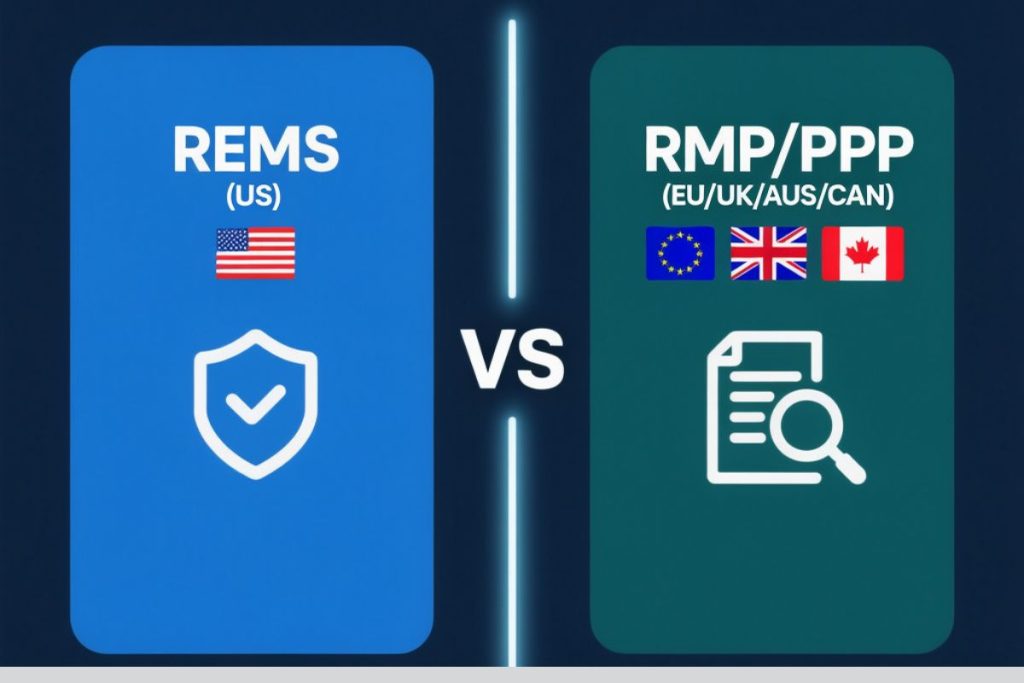
REMS vs RMP/PPP (US vs EU/UK/AUS/CAN)
What Is the Same (Goal, Counseling, Prevention)
No matter where you live, the core safety goals are identical:
- Prevent pregnancy exposure – The number one goal everywhere
- Patient education – Everyone receives counseling about risks
- Prescriber training – Doctors must complete safety training
- Pregnancy testing – Required before and during treatment
- Contraception requirements – Two effective methods required
- Documentation – All steps must be recorded
What Is Different (Enrollment, Forms, Oversight)
| Feature | US (REMS) | EU (RMP) | UK (PPP) | Australia/Canada |
| Program name | REMS (FDA required) | Risk Management Plan | Pregnancy Prevention Programme | Varies by region; similar to PPP |
| Online portals | Separate for each drug | May use national systems | NHS/MHRA systems | Provincial or national systems |
| Authorization numbers | Required for every prescription | May not use auth numbers | Provider must document compliance | Varies; documentation required |
| Survey frequency | Monthly for all drugs | May vary by country | Monthly or as required | Similar to UK |
| Pharmacy certification | Must certify in each REMS | May have national registration | NHS pharmacy requirements | Regional pharmacy standards |
| Oversight agency | FDA | EMA + national agencies | MHRA | TGA (AUS), Health Canada |
The biggest difference is the paperwork system. US REMS programs require authorization numbers and use separate websites for each drug. European and other systems may connect to national health records instead.
Helpful Links by Region
United States:
- FDA REMS Information: https://www.fda.gov/drugs/drug-safety-and-availability/risk-evaluation-and-mitigation-strategies-rems
- FDA REMS Database: https://www.accessdata.fda.gov/scripts/cder/rems/index.cfm
- Revlimid REMS: revlimidrems.com
- Pomalyst REMS: pomalystrems.com
- Thalomid REMS: thalomidrems.com
European Union:
- EMA Medicines Database: https://www.ema.europa.eu/en/medicines
United Kingdom:
- MHRA Drug Safety Updates: https://www.gov.uk/drug-safety-update
Canada:
- Health Canada Drug Database: https://health-products.canada.ca/dpd-bdpp/index-eng.jsp
Australia:
- TGA Safety Information: https://www.tga.gov.au/
Always check with your local prescriber for the most current program requirements in your country.
If Something Goes Wrong
Missed Survey or Test
What happens: Your refill gets blocked automatically. The computer system won’t generate a new authorization number.
What to do:
- Call your doctor’s office immediately
- Schedule the missed pregnancy test right away
- Complete the overdue survey as soon as possible
- Once completed, your doctor can get a new authorization number
- Get your prescription filled within 7 days
Most delays can be fixed within 1-2 days if you act quickly.
Refill Blocked or Authorization Expired
Common reasons for blocked refills:
- Authorization number expired (more than 7 days old)
- Monthly survey not completed
- Pregnancy test results not entered
- Previous prescription not picked up
- Patient consent forms expired (usually yearly renewal)
How to fix it:
- Check which step is missing (call REMS program or your doctor)
- Complete the missing requirement
- Wait for system to update (can take 1-24 hours)
- Get new prescription with new authorization number
- Don’t panic most blocks are fixable same-day or next-day
Prevention tips:
- Complete surveys a few days before you need your refill
- Schedule pregnancy tests regularly (same day each month)
- Set phone reminders for survey deadlines
- Renew consent forms before they expire
- Pick up prescriptions within 2-3 days (don’t wait until day 7)
Who to Call for Help
For enrollment or survey problems:
- Call the specific REMS program (number on your medicine bottle or website)
- Hours: Usually Monday-Friday, 8 AM to 8 PM Eastern Time
For medical questions or prescription issues:
- Call your prescribing doctor’s office
- Your doctor can contact REMS support directly if needed
For pharmacy problems:
- Talk to your pharmacist first
- They can check verification issues in the system
For emergencies: If you accidentally became pregnant or someone else took your medicine, call your doctor immediately and also report to the REMS program.
FAQs
1. What is the Celgene risk management program?
It’s a set of safety rules for medicines that can cause severe birth defects. The program makes sure patients, doctors, and pharmacies all follow steps to prevent pregnancy exposure and keep treatment safe.
2. Which drugs are in the Celgene/BMS REMS?
Revlimid (lenalidomide), Pomalyst (pomalidomide), and Thalomid (thalidomide) are the three main drugs with REMS requirements in the United States.
3. How do I enroll in the REMS as a patient?
Your doctor enrolls you after counseling and consent forms. You’ll receive login information to complete surveys. You cannot enroll yourself it must start with a certified prescriber.
4. What tests do I need before each refill?
If you can become pregnant, you need a pregnancy test every 4 weeks. All patients complete a short survey each month confirming they understand the safety rules.
5. Why are birth control rules so strict?
Because even one dose of these medicines during pregnancy can cause severe, life-threatening birth defects including missing limbs, organ problems, and developmental disabilities. Two forms of contraception reduce the risk to nearly zero.
6. What happens if I miss a survey?
Your refill will be blocked until you complete it. The system automatically stops authorization numbers when surveys are overdue. Complete it as soon as possible, then contact your doctor for a new prescription.
7. Do prescribers and pharmacies need special training?
Yes. Both must complete online certification before they can prescribe or dispense these medications. Training covers the risks, requirements, and how to use the REMS system.
8. How is REMS different from EU RMP or PPP?
The goals are the same (prevent pregnancy exposure), but the paperwork differs. REMS uses authorization numbers and separate portals for each drug. European systems may integrate with national health records and have different documentation requirements.
9. Can I donate blood while on these medicines?
No. You cannot donate blood, sperm, or eggs while taking REMS medications and for at least 4 weeks after stopping. This prevents accidental exposure to pregnant people through transfusions or donations.
10. Where do I find the official REMS website?
Each drug has its own site: revlimidrems.com, pomalystrems.com, or thalomidrems.com. Your doctor or pharmacist will give you the correct link when you start treatment.
11. Who do I call if my refill is blocked?
First, call your doctor’s office and they can see what’s missing in the system. If it’s a technical problem, they’ll contact the REMS program support line for you.
12. Is this the same as financial assistance?
No. REMS is a safety program required by the FDA. Financial assistance and co-pay help are separate programs. Ask your doctor’s office about BMS patient support programs if you need help paying for medication.
Pros and Cons of REMS/RMP Programs
Pros (Benefits)
✅ Protects patients and unborn babies The strict rules have prevented thousands of birth defects since these programs began. The safety record is excellent.
✅ Standard safety steps for all Everyone follows the same process, so there’s no confusion about what’s required. Doctors know what to expect.
✅ Education for patients and healthcare providers Training ensures everyone understands the real risks and how to prevent them. Knowledge saves lives.
✅ Tracks compliance and safety events The system monitors if patients are following the rules and catches problems early. Data helps improve the programs.
Cons (Challenges)
❌ Extra steps before refills Monthly surveys and tests add time and appointments. You can’t just call in a refill like with other medicines.
❌ More paperwork and logins Multiple forms, websites, and consent documents can feel overwhelming, especially at first.
❌ Can delay treatment if a step is missed Forgetting a survey or being late for a pregnancy test blocks your medicine until you catch up.
❌ Can be confusing without clear guidance The rules are detailed and different for each medicine. Patients need good support from their healthcare team to navigate the system smoothly.
Most patients say the benefits outweigh the hassles once they get used to the routine. Setting up reminders and staying organized makes it much easier.
PEOPLE ALSO READ : Top 100 SaaS Companies 2025 Best Software Solutions
Sources and Official Links
This guide is based on information from official regulatory agencies and manufacturer resources:
- FDA Risk Evaluation and Mitigation Strategies (REMS)
https://www.fda.gov/drugs/drug-safety-and-availability/risk-evaluation-and-mitigation-strategies-rems - FDA REMS Database
https://www.accessdata.fda.gov/scripts/cder/rems/index.cfm - Revlimid (lenalidomide) Prescribing Information
https://packageinserts.bms.com/pi/pi_revlimid.pdf - Pomalyst (pomalidomide) Prescribing Information
https://packageinserts.bms.com/pi/pi_pomalyst.pdf - Thalomid (thalidomide) Prescribing Information
https://packageinserts.bms.com/pi/pi_thalomid.pdf - European Medicines Agency (EMA) – Medicines Database
https://www.ema.europa.eu/en/medicines - UK MHRA Drug Safety Updates
https://www.gov.uk/drug-safety-update - Health Canada Drug Product Database
https://health-products.canada.ca/dpd-bdpp/index-eng.jsp - Therapeutic Goods Administration (Australia) – Safety Information
https://www.tga.gov.au/
Always verify program requirements with official sources, as rules and website addresses may change. Celgene is now part of Bristol Myers Squibb, so some program names and portals may have been updated.
Disclaimer (Education, Not Medical Advice)
Important: Please read carefully.
This article provides general educational information about Celgene risk management programs, REMS, and related safety requirements. It is NOT medical advice and should not replace guidance from your healthcare providers.
This guide does not:
- Tell you whether these medicines are right for you
- Replace your doctor’s instructions
- Cover every possible situation or side effect
- Provide legal or professional medical advice
- Guarantee information is complete or current
Always:
- Follow your doctor’s specific instructions for your treatment
- Read the medication guide provided with your prescription
- Ask your healthcare team if you have questions
- Check official REMS websites for the most current requirements
- Contact your doctor immediately if you have serious side effects
Program changes: REMS and RMP/PPP requirements can change. Rules, forms, testing schedules, and website addresses may be updated by regulatory agencies. Always verify current requirements through official channels.
Company information: Celgene is now part of Bristol Myers Squibb (BMS). Program names, portals, and contact information may vary depending on when you access this information.
Regional differences: This guide covers US, European, UK, Canadian, and Australian programs in general terms. Specific requirements in your country or region may differ. Consult local healthcare providers and regulatory agency websites for precise rules where you live.
No liability: The author and publisher are not responsible for any consequences of using this information. This guide is provided “as is” for educational purposes only.
If you are pregnant, think you might be pregnant, or are planning pregnancy, contact your doctor immediately before taking or continuing these medications.
READ MORE : Super Converters