

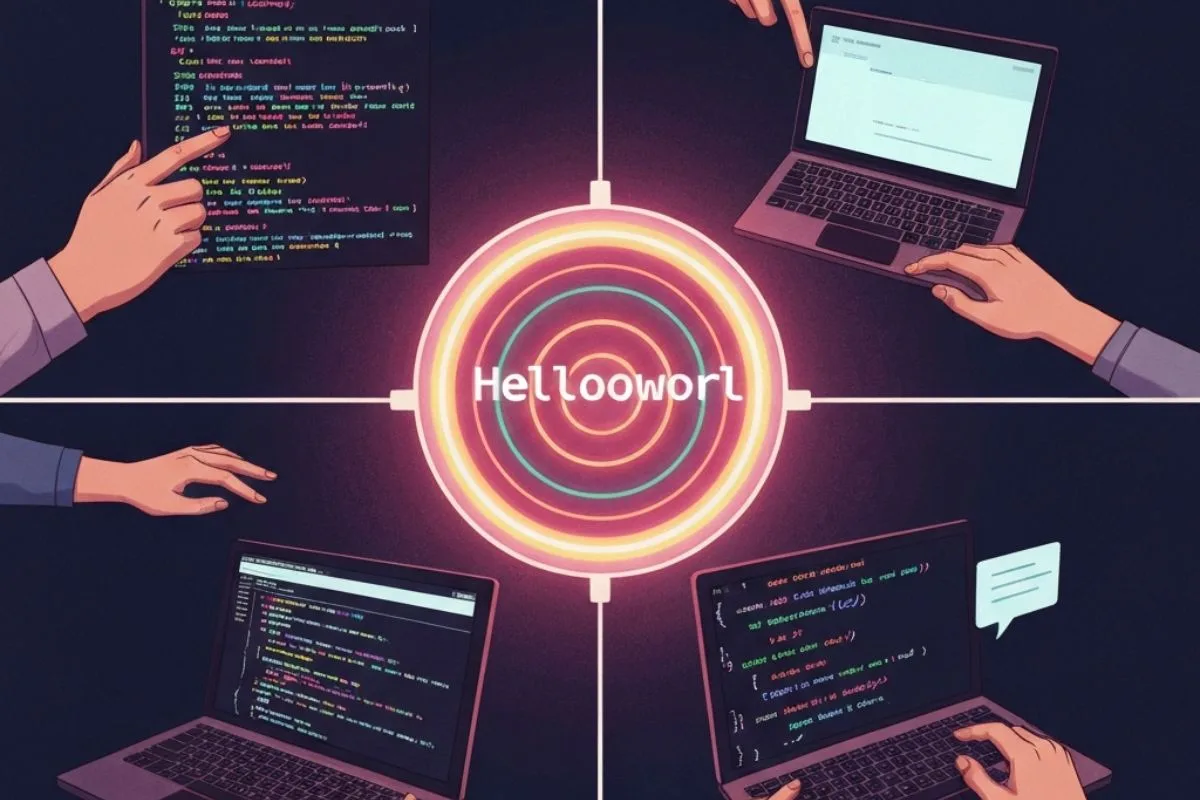
Look, I know what you’re thinking. “Hellooworl” looks like someone’s cat walked across their keyboard. But here’s the thing, this weird little typo has quietly become one of the most relatable symbols in programming culture. It’s not just a mistake. It’s our mistake. The one we’ve all made.
If “Hello, World” is that picture-perfect Instagram post, Hellooworl is the blooper reel. And honestly? The blooper reel is where the real story lives.
How We Got Here: From Textbook Example to Cultural Icon
Let’s rewind to the 1970s. “Hello, World” showed up in a C programming book as the simplest possible program. The whole point was just to prove you could make the computer do something. Print those two words, and boom you’re officially a programmer.
Fast forward to today, and “Hello, World” has become this sacred ritual. It’s in every tutorial, every coding bootcamp, every “Learn to Code in 24 Hours” YouTube video. It’s the handshake of the programming world.
But then there’s Hellooworl.
Nobody planned it. Nobody designed it. It just… happened. Someone was typing fast, missed a key, forgot a space, and suddenly there it was on their screen. And instead of being embarrassed, they probably laughed. Because that’s exactly how coding actually goes.
That’s the magic of it. Hellooworl feels real in a way that the perfect example never could.
PEOPLE ALSO READ : chuck kim vesta technology Role, Background, and News
Your First Program Probably Looked Like This
Remember your first time writing code? Maybe you were excited, maybe nervous, definitely a little confused. You carefully typed out:
print(“Hello, World!”)
And then… nothing worked.
Maybe you forgot the closing quote. Maybe you used single quotes when the example showed double quotes. Maybe your finger slipped and you wrote “Helo” or “Wrold” or yes, “Hellooworl.”
Here’s what nobody tells beginners: this is completely normal.
Every single programmer (and I mean every single one) has:
- Spent 20 minutes debugging a problem that was just a missing semicolon
- Copy pasted code that still didn’t work
- Sworn the computer was broken when really they just had a typo
- Felt like an idiot over something incredibly simple
Hellooworl captures all of that. It’s the embodiment of “yep, been there, done that, got the syntax error.”
Why Programmers Actually Love This “Mistake”
So why has Hellooworl stuck around? Why do developers put it on t-shirts, reference it in conversations, and occasionally use it in their own code?
Because it represents something we all understand:
Nobody starts out good at this. The journey from “What’s a variable?” to “I just built an app” is paved with broken code and weird error messages. Hellooworl is a reminder that the messy part is actually the important part.
Perfectionism is overrated. The developers who succeed aren’t the ones who never make mistakes (they’re the ones who make mistakes, shrug, and keep going. Hellooworl says “it’s okay if things are a little broken right now.”
We’re all in this together. When someone drops a Hellooworl reference, they’re signaling “I get it, I’ve been there too.” It’s like a secret handshake, except the secret is that we’ve all struggled with the exact same stupid things.
In a field that can feel intimidating and gatekeepy, having a shared symbol for “we all mess up sometimes” is actually kind of beautiful.
The Computer Doesn’t Care If You’re Wrong
Here’s something wild: if you write print(“Hellooworl”), your computer will happily print “Hellooworl.” No complaints. No judgment. It’ll do exactly what you told it to do.
The computer doesn’t know you meant “Hello, World.” It doesn’t care about English spelling or grammar or meaning. It just sees a string of characters and outputs them.
This is one of those moments where the gap between human thinking and machine logic becomes really obvious. To us, “Hellooworl” is clearly wrong. To the computer, it’s just another Tuesday.
And that’s fascinating, right? It shows how coding sits at this intersection between human creativity (messy, emotional, full of intent) and machine precision (literal, exact, utterly indifferent to what you meant).
Hellooworl lives right in that gap. It’s syntactically perfect but semantically broken, at least from our human perspective.
From Code Editor to Culture
What started as a typo has leaked out into the wider world of tech culture. You’ll find Hellooworl on:
- Conference stickers
- Coding meme accounts
- Developer merchandise
- Welcome messages in some apps and tools
- That one friend’s laptop covered in programming jokes
People use it as a gentle way to say “learning is messy, and that’s fine.” It’s especially popular in spaces that are trying to be welcoming to beginners coding bootcamps, beginner-friendly forums, educational content.
Because let’s be real: tech can be intimidating. There’s so much jargon, so many people who seem to know everything, so much pressure to get it right. A tiny thing like Hellooworl helps soften all that. It says “hey, even the pros started by typing garbage into a text editor and hoping something would happen.”
The Pushback (Yes, There’s Always Pushback)
Of course, not everyone loves the idea. Some people argue:
“Doesn’t this just encourage sloppiness?” Well, no. Nobody’s saying you should ship broken code to production. Hellooworl isn’t about writing bad code it’s about accepting that learning involves making mistakes.
“Programming is serious business.” It absolutely is. Code runs hospitals, banks, power grids, all kinds of critical infrastructure. But you know what? Every person who writes that critical code started somewhere. They started with broken, messy, trial-and-error attempts. Acknowledging that doesn’t diminish the seriousness of the craft.
“Isn’t this just an in-joke that excludes people?” It could be, but it’s actually one of the most inclusive in-jokes out there. Because the moment you write your first program and it doesn’t work, you’re in on it. You get it instantly.
The bottom line: Hellooworl isn’t replacing discipline or best practices. It’s just reminding us that the path to competence goes through a lot of incompetence first.
What Curiosity Actually Looks Like
Programming, at its heart, is about curiosity:
- What if I change this variable?
- Why did it crash when I added that line?
- Can I make this work differently?
- What happens if I do something the tutorial didn’t mention?
Hellooworl captures that experimental spirit. It’s what happens when you stop treating code like sacred text and start treating it like a playground.
The people who become great programmers aren’t necessarily the smartest or the ones who memorized the most syntax. They’re the ones who kept poking at things, breaking stuff, asking questions, and trying again.
That playful curiosity the willingness to type something “wrong” just to see what happens that’s what drives innovation. Every major breakthrough in tech came from someone who was willing to deviate from the standard example.
Looking Forward
Will Hellooworl be around forever? Probably not in some official capacity. It’s not going to replace “Hello, World” in textbooks or become part of programming standards.
But that’s fine. Its value isn’t in being permanent it’s in what it represents.
As long as people are learning to code, there will be typos. There will be frustration. There will be that moment when you finally get something to run, even if the output looks a little weird.
And as long as that’s true, we’ll need symbols like Hellooworl to remind us that the messy, imperfect, very human part of coding is not just acceptable it’s essential.
The Real Takeaway
Hellooworl looks like a mistake because it is one. And that’s exactly why it matters.
Every sleek app you use, every website that loads smoothly, every piece of software that “just works” behind all of that are thousands of broken attempts. Code that didn’t run. Syntax errors. Weird output. Mistakes that taught someone something.
Hellooworl is a tiny monument to all of that. It reminds us that:
- Learning is supposed to be messy
- Mistakes aren’t failures, they’re data
- The distance between “beginner” and “expert” is just a lot of broken code
- Curiosity matters more than perfection
So the next time you’re staring at an error message, wondering if you’re cut out for this, remember: somewhere out there, someone typed “Hellooworl” instead of “Hello, World” and kept going anyway.
That’s the spirit that builds things.
PEOPLE ALSO READ : FTAsiaStock Technology News The Ultimate Guide to Asian Tech Market Intelligence [2024]
Questions You Might Have
Okay, but what actually IS Hellooworl?
It’s a misspelled version of “Hello, World” that classic first program everyone writes when learning to code. Over time, it’s become a kind of cultural shorthand for the messy reality of learning programming, where things rarely work perfectly the first time.
Why should I care about a typo?
Because it’s not really about the typo. It’s about what the typo represents: that learning to code involves making tons of mistakes, and that’s not just okay it’s normal and necessary. In a field that can feel gatekeep-y, having a symbol that says “we all mess up” is actually pretty valuable.
Who came up with this?
Nobody specifically. It’s one of those organic culture things that just emerged from the collective experience of people learning to code. Lots of people have typed “Hellooworl” by accident. Someone just decided to embrace it instead of being embarrassed about it.
Is this encouraging people to write sloppy code?
Not at all. There’s a difference between accepting mistakes as part of learning and writing careless code. Hellooworl is about the learning process, not about lowering standards. Every expert programmer started by writing terrible code. The path to quality goes through messiness.
Where might I see this used?
Developer t-shirts, coding memes, conference stickers, welcome screens in learning platforms, tech blogs aimed at beginners. It’s popular in spaces that want to signal “mistakes are welcome here” and “you don’t have to be perfect.”
Doesn’t this create an in-group/out-group thing?
It could, but honestly, it’s one of the most inclusive inside jokes in tech. The moment you write your first buggy program, you get it. Unlike a lot of tech jargon that excludes people, Hellooworl actually says “hey, if you’ve ever messed something up, you’re one of us.”
Why do computers just print whatever you tell them to?
Because computers are literal machines. They don’t understand meaning or intent—they just follow instructions exactly. If you tell it to print “Hellooworl,” it doesn’t know you “meant” something else. This gap between human meaning and machine execution is part of what makes programming both frustrating and fascinating.
Is there, like, a deeper meaning here?
Kind of, yeah. Hellooworl sits at this intersection of human language (messy, meaningful, full of mistakes) and programming language (precise, literal, unforgiving). It reminds us that coding is ultimately a human activity, even though we’re talking to machines. The imperfections are where the humanity shows through.
Will this become a permanent thing in programming culture?
Probably not in any official way, but that’s fine. Its job isn’t to be enshrined in textbooks it’s to remind people that the journey is messy. Even if this specific term fades, the need for symbols that normalize struggle and experimentation will always be there.
What’s the actual lesson here?
That curiosity, persistence, and a willingness to make mistakes matter more than getting everything right the first time. Behind every polished piece of software are countless broken attempts, weird outputs, and moments of “wait, why didn’t that work?” Hellooworl is just a fun way to acknowledge that reality.
I’m learning to code and I keep messing up. Is that normal?
Completely, totally, 100% normal. Every programmer you admire started exactly where you are now confused, making tons of mistakes, Googling error messages, feeling lost. The difference between them and someone who gave up isn’t that they were smarter or more talented. They just kept going. That’s it. That’s the whole secret.
So basically, Hellooworl is about being okay with sucking at first?
Yeah, pretty much. It’s about embracing the messy part of learning instead of feeling ashamed of it. Everyone sucks at first. The people who get good are just the ones who were okay with sucking for a while. Hellooworl is a reminder that the mess is where the learning happens.
READ MORE : Super Converters