


Quick Definition: A Project Information Memorandum (PIM) is a clear, non-binding document that explains a project’s value, risks, timeline, and terms to potential investors or bidders so they can decide whether to engage. It serves as the primary disclosure tool in project finance, PPP deals, and infrastructure transactions.
What Is a Project Information Memorandum (PIM)?
Plain‑English Definition
A Project Information Memorandum(PIM) is a structured report that lays out everything a serious investor needs to evaluate a project deal. Think of it as a business plan meets sales pitch meets risk disclosure all in one package.
Unlike a teaser (which hints) or a pitch deck (which persuades), a Project Information Memorandum(PIM) informs. It gives facts: what the project does, how much it costs, who runs it, what can go wrong, and when money flows in and out.
Project Information Memorandum(PIM) are common in:
- Infrastructure: Roads, bridges, ports, airports
- Energy: Solar farms, wind parks, power plants
- Real estate: Large developments, mixed-use projects
- Transport: Rail lines, tunnels, bus rapid transit
Who Uses It and When
Sellers/Sponsors send Project Information Memorandum(PIM) to pre-qualified investors after a teaser has sparked interest but before due diligence begins.
Investors/Buyers use the Project Information Memorandum(PIM) to:
- Screen deals quickly (10–15 minutes for first pass)
- Decide whether to request full data room access
- Model preliminary returns
- Identify deal-breaker risks
When to send: After NDA signing, before indicative bids. Typical window: 2–4 weeks for investor review.
PEOPLE ALSO READ : Grow a Garden Calculator: Plan Space, Dates, Plants, and Yield
PIM vs IM vs PPM vs Teaser
| Document | Use Case | Audience | Typical Length | Legal Status | When Used |
| Project Information Memorandum(PIM) | Project-based deals (infrastructure, energy, PPP) | Pre-qualified institutions | 30–80 pages | Non-binding | After teaser, before data room |
| IM | Corporate M&A, business sales | Strategic buyers, PE firms | 50–150 pages | Non-binding | Mid-process, post-NDA |
| PPM | Fund raises, securities offerings | Accredited/qualified investors | 100+ pages | Legally binding disclosure | Formal fundraise (Reg D, etc.) |
| Teaser | Initial interest generation | Wide net, cold outreach | 1–4 pages | Non-binding, minimal detail | First contact, no NDA |
| Pitch Deck | Persuasion, storytelling | VCs, early-stage investors | 10–20 slides | Non-binding | Meetings, presentations |
Key difference: A Project Information Memorandum(PIM) focuses on project assets (physical, contracted, regulated). An IM focuses on company operations (teams, customers, EBITDA). A PPM is a legal offering document with liability attached.
What to Include: Project Information Memorandum(PIM) Structure and Checklist
A strong Project Information Memorandum(PIM) follows this structure. Use this as your table of contents:
| Section | Pages | What to Include | Investor Priority |
| Executive Summary | 2–3 | Deal snapshot, investment thesis, key numbers | HIGH |
| Project Overview | 4–6 | Scope, assets, technology, delivery model | HIGH |
| Market & Demand | 5–8 | Sector trends, competitive position, off-takers | HIGH |
| Delivery Plan | 4–6 | Timeline, milestones, construction/ops phases | MEDIUM |
| Financial Summary | 6–10 | Revenue model, capex/opex, IRR, NPV, debt terms | HIGH |
| Risks & Mitigations | 4–6 | Risk matrix, sensitivity analysis, insurance | HIGH |
| Legal, Permits, ESG | 3–5 | Approvals, compliance, environmental impact | MEDIUM |
| Team & Governance | 2–3 | Sponsor track record, advisors, decision rights | MEDIUM |
| Appendices | 5–10 | Glossary, maps, charts, assumptions | LOW (reference) |
Executive Summary
Your 2-page “sell sheet.” Include:
- One-sentence project description
- Total project cost and equity ask
- Expected returns (IRR, equity multiple)
- Deal structure (SPV, partnership, offtake contracts)
- Timeline: financial close, start construction, revenue
- Why now? (regulatory tailwind, demand spike, etc.)
Do: Write this last after all sections are final.
Don’t: Use jargon or assume prior knowledge.
Project Overview and Scope
Answer these:
- What does the project build or operate?
- Where is it located? (maps, site photos)
- What is the capacity? (MW, km, units, daily throughput)
- What technology or design is used?
- Who are the off-takers or end users?
Example (Solar Farm):
“Project Sunburst is a 150 MW solar PV farm in Queensland, Australia. It will supply renewable energy to the national grid under a 15-year power purchase agreement (PPA) with Origin Energy. The site spans 200 hectares and uses bifacial panels with single-axis trackers.”
Market, Demand, and Competition
Investors want proof the project will have customers. Include:
- Market size and growth rate (cite World Bank, OECD, industry reports)
- Demand drivers (population, policy, electrification)
- Competitor landscape (how many similar projects? price points?)
- Contracts in place (PPAs, concession agreements, reservation deposits)
Do: Show signed contracts > letters of intent > demand studies.
Don’t: Over-rely on forecasts without anchoring to real commitments.
Delivery Plan and Timeline
A Gantt chart or milestone table showing:
- Pre-construction (permits, financing, land acquisition): months 1–6
- Construction phase: months 7–24
- Commissioning and testing: months 25–27
- Commercial operations start: month 28
- Handback or exit: year 20
Flag any critical-path risks (permit delays, supply chain, weather).
Financial Summary (Key Metrics)
The most-skimmed section. Lead with a one-page table:
| Metric | Value |
| Total Project Cost | $250M |
| Equity Required | $75M (30%) |
| Senior Debt | $175M (70%) |
| Weighted Avg. Cost of Capital | 6.8% |
| Unlevered IRR | 8.5% |
| Levered IRR (equity) | 14.2% |
| Payback Period | 9 years |
| NPV @ 8% discount | $42M |
| Revenue (Year 1) | $18M |
Then add:
- Revenue model (tariffs, volume, escalation)
- Cost breakdown (capex, opex, O&M, insurance)
- Debt terms (tenor, amortization, covenants)
- Base, upside, downside scenarios
Do: Provide Excel model for serious investors (password-protected in data room).
Don’t: Hide assumptions or use circular logic.
Risks and Mitigations
Create a risk matrix (see template below). Rate each risk by likelihood and impact, then show your mitigation.
Common project risks:
- Construction: delays, cost overruns → fixed-price EPC contract
- Revenue: demand shortfall → take-or-pay PPA
- Regulatory: policy change → grandfathering clause
- Foreign exchange: currency mismatch → hedging strategy
- Force majeure: earthquakes, floods → insurance, design standards
Do: Be honest. Investors trust transparency.
Don’t: List risks without solutions—that’s not a mitigation plan.
Legal, Permits, and ESG
Checklist format works well:
- Land title secured
- Environmental impact assessment approved
- Building permit (expected Q2 2026)
- Grid connection agreement signed
- Community consultation complete
Include ESG highlights:
- Jobs created (construction + permanent)
- CO₂ avoided (for green projects)
- Community benefit programs
- Compliance with IFC Performance Standards or Equator Principles
Team, Governance, and Contacts
Introduce the sponsor, developer, and advisors:
- Track record: similar projects delivered, on time/budget
- Organizational chart: who decides what
- Advisory team: legal, technical, financial advisors
- Contact: deal lead name, email, phone
Do: Show credibility through past successes.
Don’t: Oversell or include irrelevant bios.
PEOPLE ALSO READ : SEO for SaaS RankStar Complete Ranking Guide
How to Write a PIM (Step‑by‑Step)
Step 1: Gather Data and Source Docs
Collect before you write:
- Feasibility study
- Financial model (Excel)
- Site plans, engineering drawings
- Contracts (EPC, PPA, O&M, land lease)
- Permits and approvals
- Market reports
- Sponsor CVs and company profiles
Step 2: Draft the Outline and Visuals
Use the checklist above as your skeleton. Add placeholders for:
- Charts (revenue waterfall, construction timeline)
- Maps (site location, grid connection)
- Photos (site, technology, team)
Tip: Visuals reduce reading time by 30–40%. Investors scan, not read.
Step 3: Build the Financial Highlights
Start with the one-page table from “Financial Summary.” Then layer in:
- Three scenarios (base, bull, bear)
- Sensitivity tornado chart (top 5 value drivers)
- Debt service coverage ratio (DSCR) by year
Step 4: Add Disclaimers and NDA Process
Every Project Information Memorandum(PIM) needs a disclaimer page (see Legal & Compliance section). Standard clauses:
- Not an offer to sell securities
- Forward-looking statements are estimates
- Recipient must verify all information
- Confidential do not distribute
Specify NDA requirements: “This Project Information Memorandum(PIM) may only be shared with recipients who have signed the Sponsor’s Non-Disclosure Agreement dated [DATE].”
Step 5: Pilot with Investors, Then Finalize
Before wide release:
- Send to 2–3 friendly investors for feedback
- Track what questions they ask (add answers to FAQ or appendix)
- Revise unclear sections
- Lock the version number and date
Do: Version control (PIM v2.1, updated Nov 8, 2025).
Don’t: Send drafts with “TBC” placeholders.
Project Information Memorandum(PIM) in 10 Minutes: What Investors Scan First
Eye-tracking studies show investors follow this pattern on first read:
- Executive Summary (2 min) → Can I understand the deal in 30 seconds?
- Key Financials table (1 min) → Does the IRR meet my hurdle rate?
- Risk Matrix (2 min) → Are there any deal-breakers?
- Team credentials (1 min) → Have they done this before?
- Timeline (1 min) → When is the exit?
- Market/Demand (2 min) → Is this sector growing?
- Skim appendices (1 min) → What backup data exists?
Total: ~10 minutes. If you pass this scan, they’ll read the full document and request the data room.
Design tip: Use bold headings, summary boxes, and page numbers. Make it easy to jump around.
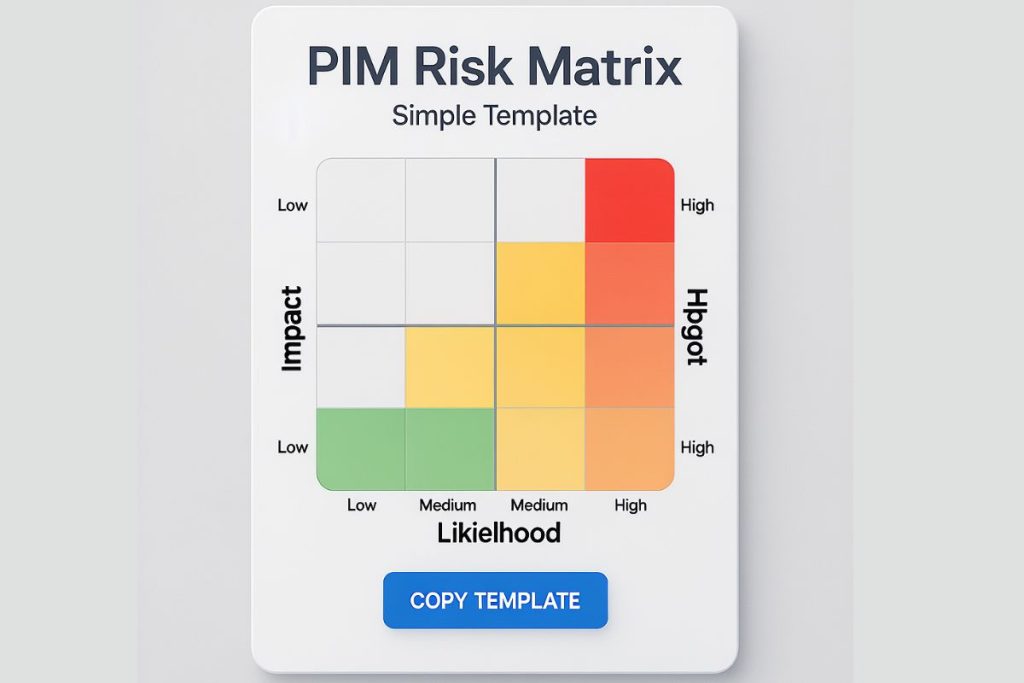
The Project Information Memorandum(PIM) Risk Matrix: Simple Template You Can Copy
| Risk | Likelihood | Impact | Score | Mitigation | Owner |
| Construction delay | Medium | High | 6 | Fixed-price EPC, liquidated damages | Developer |
| Demand shortfall | Low | High | 4 | Take-or-pay PPA with investment-grade off-taker | Commercial team |
| Regulatory change | Low | Medium | 2 | Grandfathering in law; legal opinion obtained | Legal counsel |
| FX volatility | Medium | Medium | 4 | Currency hedge (3-year forward contract) | CFO |
| Cost overrun | Medium | High | 6 | Contingency reserve (8% of capex) | Project manager |
Scoring: Likelihood (Low=1, Med=2, High=3) × Impact (Low=1, Med=2, High=3) = Risk score.
Heat colors: 1–2 green (low), 3–4 yellow (watch), 6–9 orange/red (high).
Legal and Compliance: US, UK, AU, CA, DE
Disclaimers and Safe‑Harbor Language
Project Information Memorandum(PIM) are not offering documents, but they still need disclaimers to limit liability. Include:
US (SEC guidance):
“This document does not constitute an offer to sell or a solicitation of an offer to buy any securities. Any such offer will only be made by means of a Private Placement Memorandum under Regulation D. Forward-looking statements are based on current assumptions and involve risks that may cause actual results to differ materially.”
UK (FCA COBS 4):
“This communication is directed only at professional clients and eligible counterparties as defined in the FCA Handbook. It is not intended for retail clients. Past performance is not indicative of future results.”
AU (ASIC RG 234):
“This document is provided for informational purposes only to wholesale clients as defined in the Corporations Act 2001 (Cth). It is not a product disclosure statement and does not constitute financial product advice.”
CA (NI 45-106):
“This information memorandum is being provided to accredited investors only, as defined by National Instrument 45-106. It has not been reviewed by any securities commission or similar regulatory authority.”
DE (BaFin/WpPG):
“Dieses Dokument stellt weder ein öffentliches Angebot noch eine Aufforderung zur Abgabe eines Angebots dar.” “Es richtet sich ausschließlich an qualifizierte Anleger gemäß §2 Nr. 6 WpPG.”
Who Can Receive Your Project Information Memorandum(PIM)
Most jurisdictions restrict distribution to:
- Accredited/sophisticated investors (net worth or income thresholds)
- Institutional investors (banks, pension funds, insurance)
- Professional advisors acting for qualified clients
Do: Maintain a distribution log (who received, when, NDA status).
Don’t: Post PIMs publicly or email without an NDA.
Data Privacy and the Data Room
If your Project Information Memorandum(PIM) names individuals or includes personal data, comply with:
- GDPR (EU/UK): Lawful basis, data minimization, right to erasure
- CCPA (California): Consumer disclosure and opt-out rights
- PIPEDA (Canada): Consent for collection and use
Best practice: Host the Project Information Memorandum(PIM) in a secure virtual data room (VDR) like Intralinks, Datasite, or DealRoom. Track who downloads what.
Project Information Memorandum(PIM) Compliance Quick Guide (US/UK/AU/CA/DE)
| Jurisdiction | Key Regulation | Investor Definition | Disclosure Requirement | Filing Needed? |
| US | Reg D (Rule 506) | Accredited investor | Forward-looking statement warnings | Form D (15 days post-sale) |
| UK | FCA COBS 4 | Professional client / HNW | Risk warnings, past performance caveats | No (unless prospectus) |
| AU | Corporations Act s708 | Wholesale client | PDS not required for wholesale | No (unless retail offer) |
| CA | NI 45-106 | Accredited investor | Material facts, no misrepresentation | No (unless prospectus) |
| DE | WpPG | Qualified investor (€100k+) | BaFin prospectus exemption | No (if under threshold) |
Source: Regulations current as of January 2025. Always consult local counsel.
Templates and Examples
Editable PIM Template (Download)
What’s included:
- MS Word template (40-page starter)
- PowerPoint summary deck (10 slides)
- Excel financial model shell
- Risk matrix spreadsheet
- Data room index checklist
How to adapt:
- Replace [PROJECT NAME] placeholders
- Insert your financials into the model
- Customize risk matrix for your sector
- Add your logo and branding
Do: Keep formatting clean (Arial or Calibri, 11pt body, 14pt headers).
Don’t: Use colored backgrounds or low-contrast text.
Data Room Index (Checklist)
Investors expect these 20 files in your VDR:
| # | Folder | Document |
| 1 | 01_Project | Feasibility study |
| 2 | 01_Project | Site plans and maps |
| 3 | 01_Project | Engineering drawings |
| 4 | 02_Financial | Full financial model (Excel) |
| 5 | 02_Financial | Independent valuation report |
| 6 | 02_Financial | Audited sponsor financials |
| 7 | 03_Legal | SPV formation documents |
| 8 | 03_Legal | Land lease or title deed |
| 9 | 03_Legal | EPC contract (redacted) |
| 10 | 03_Legal | PPA or offtake agreement |
| 11 | 03_Legal | O&M contract |
| 12 | 04_Permits | Environmental impact assessment |
| 13 | 04_Permits | Building permit |
| 14 | 04_Permits | Grid connection approval |
| 15 | 05_Market | Market study or demand forecast |
| 16 | 05_Market | Competitor analysis |
| 17 | 06_Team | Sponsor company profile |
| 18 | 06_Team | CVs of key personnel |
| 19 | 06_Team | Advisor engagement letters |
| 20 | 07_Insurance | Insurance policies (construction, liability) |
Tip: Use numbered folders (01, 02…) so files sort correctly. Add a README.txt with instructions.
Sample Risk Matrix
See section above: “The PIM Risk Matrix: Simple Template You Can Copy.”
Use Cases and Distribution
PPP and Project Finance
Public-Private Partnerships (PPP) often require a PIM during the request for proposals (RFP) phase. Governments or procuring authorities issue an RFP; bidders respond with a PIM outlining their technical and financial approach.
Key differences in PPP PIMs:
- Heavier on public benefit (jobs, social impact, value for money)
- Must comply with procurement law (e.g., World Bank PPP Framework, APMG standards)
- Often include a financial model as a separate submission
Sources: World Bank PPP Reference Guide; APMG PPP Certification Program.
Private Deals and M&A
In private project sales (no government involved), the sponsor controls the process:
- Teaser → gauge interest from 20–30 investors
- NDA + PIM → send to 8–12 serious parties
- Data room access → grant to 4–6 bidders
- Indicative offers → receive bids
- Management presentations → meet top 2–3
- Binding bids → select winner
- Due diligence → 60–90 days
- Financial close → sign and fund
Timeline: 4–9 months from teaser to close.
Teaser vs Project Information Memorandum(PIM) vs Pitch Deck
Use this decision tree:
- Cold outreach, no NDA: Send a teaser (1–4 pages, high-level only).
- Warm lead, NDA signed, serious interest: Send the PIM (30–80 pages, full disclosure).
- Face-to-face meeting, need to persuade: Use a pitch deck (10–20 slides, storytelling).
Never send the PIM without an NDA. Never pitch live using the Project Information Memorandum(PIM)—it’s too dense.
Track Opens, Replies, and Q&A
Use VDR analytics or email tracking (HubSpot, DocSend) to monitor:
- Who opened the Project Information Memorandum(PIM)
- Time spent per section
- Which documents were downloaded
- Questions asked (compile into FAQ for later rounds)
Insight: If no one reads the risk section, it’s probably too long or buried. Move it forward.
FAQs Project Information Memorandum(PIM)
What is a project information memorandum?
A Project Information Memorandum(PIM) is a detailed, non-binding document that discloses a project’s structure, financials, risks, and terms to pre-qualified investors, helping them decide whether to pursue the deal.
What should a Project Information Memorandum(PIM) include?
At minimum: executive summary, project overview, market analysis, financial model, risk matrix, legal/ESG compliance, team credentials, and disclaimers.
How long should a Project Information Memorandum(PIM) be?
30–80 pages is standard. Under 30 looks incomplete; over 100 loses attention. Appendices can extend the page count.
Is a Project Information Memorandum(PIM) legally binding?
No. Project Information Memorandum(PIM) are informational and include disclaimers stating they are not offers or contracts. Binding terms come later in a definitive agreement.
What is the difference between Project Information Memorandum(PIM) and IM?
A Project Information Memorandum(PIM) focuses on project assets (infrastructure, energy, real estate developments). An IM focuses on corporate entities (businesses being sold in M&A).
What is the difference between Project Information Memorandum(PIM) and PPM?
A PPM (Private Placement Memorandum) is a legal offering document for securities, with liability for misstatements. A Project Information Memorandum(PIM) is informational only.
When should you send a Project Information Memorandum(PIM) to investors?
After a teaser generates interest and the investor signs an NDA, but before granting full data room access.
Do you need an NDA to send a Project Information Memorandum(PIM)?
Yes, always. Project Information Memorandum(PIM) contain confidential business and financial information that could harm the project if leaked.
How do you write a Project Information Memorandum(PIM) for PPP projects?
Include public benefit metrics (social ROI, jobs, environmental gains), comply with procurement rules, and align with government evaluation criteria (e.g., value for money).
What is a Project Information Memorandum(PIM) risk matrix?
A table that lists project risks, rates them by likelihood and impact, assigns a score, and details the mitigation strategy for each.
What disclaimers should be in a Project Information Memorandum(PIM) (US/UK/AU/CA/DE)?
Include “not an offer,” forward-looking statement warnings, professional-investor-only language, and jurisdiction-specific safe harbors (see Legal & Compliance section).
Can a Project Information Memorandum(PIM) replace a data room?
No. A Project Information Memorandum(PIM) is a summary to help investors decide whether to enter due diligence. The data room holds the full backup documents (contracts, permits, models).
PEOPLE ALSO READ : Snow Day Calculator: Exciting Chance of No School
Pros and Cons of Using a Project Information Memorandum(PIM)
Pros
✅ Speeds investor screening: Serious bidders self-identify; tire-kickers drop out.
✅ Aligns stakeholders: Internal team agrees on the story before marketing.
✅ Reduces Q&A volume: One comprehensive doc answers 80% of questions.
✅ Improves bid quality: Investors bid based on real data, not guesses.
✅ Supports valuation: Transparent financials justify your asking price.
✅ Professionalizes outreach: Shows you’re organized and credible.
Cons
❌ Time-intensive: Expect 4–8 weeks to draft, review, and finalize.
❌ Needs updates: If deal terms change, you must revise and redistribute.
❌ Risk of oversharing: Too much detail can scare investors or reveal competitive info.
❌ Legal exposure if mis-stated: Even “non-binding” docs can trigger liability if fraudulent.
❌ Not a funding guarantee: A great PIM doesn’t guarantee investment it just opens the door.
Deal Timeline: Prep → Send → Q&A → Bids
| Phase | Duration | Milestones |
| Prep | 4–8 weeks | Gather docs, draft PIM, internal review, add disclaimers |
| Teaser | 1–2 weeks | Send teaser, field inquiries, shortlist 10–15 interested parties |
| NDA & PIM | 2–4 weeks | Circulate NDA, send PIM to signed parties, host Q&A webinar |
| Indicative Bids | 2–3 weeks | Receive non-binding offers, select top 3–5 bidders |
| Data Room | 4–6 weeks | Grant VDR access, answer detailed questions, site visits |
| Binding Bids | 1–2 weeks | Final offers submitted |
| Negotiation | 4–8 weeks | Term sheets, exclusivity, final due diligence |
| Financial Close | 2–4 weeks | Sign definitive agreements, fund transaction |
READ MORE : Super Converters