

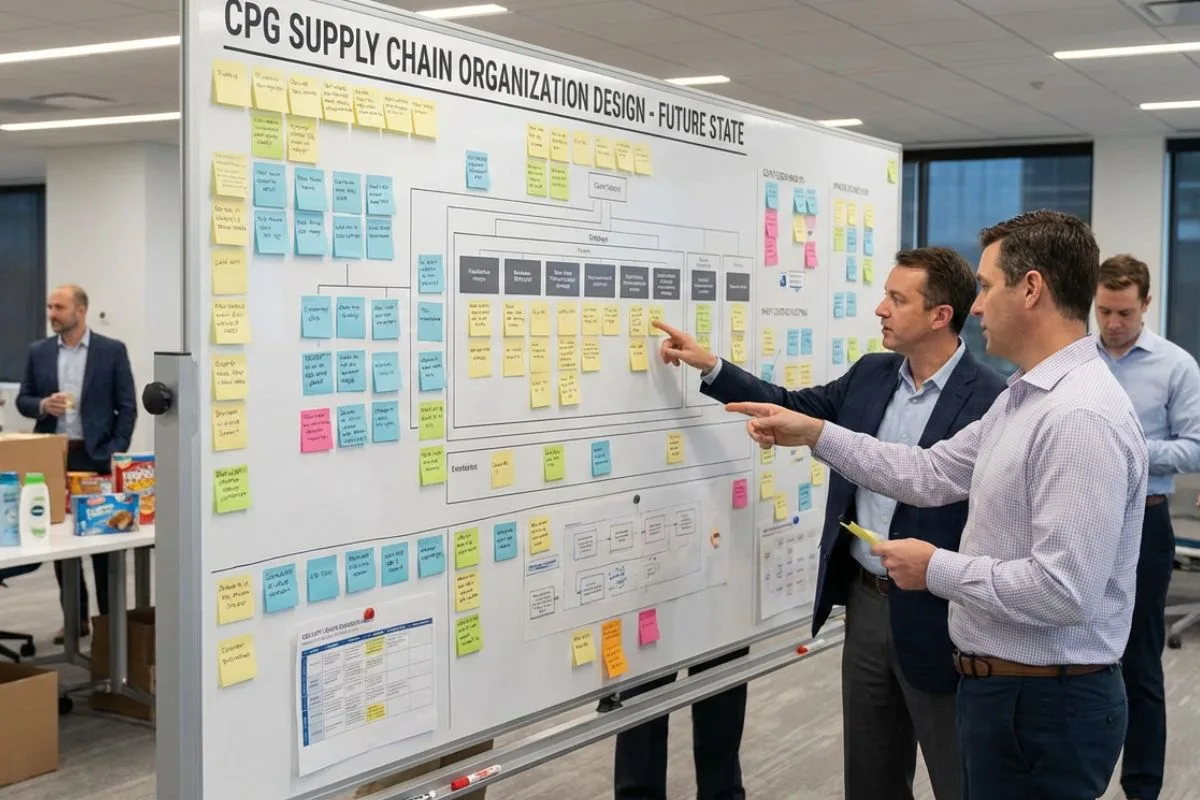
This guide is for CPG brand leaders, supply chain directors, and operations managers who know their current organization isn’t keeping pace with today’s demands. If you’re a founder scaling a food or beverage brand, a VP trying to reduce stockouts while cutting costs, or a supply chain leader dealing with constant firefighting, this article will help you design a better team structure.
Consumer Packaged Goods (CPG) refers to products consumers use and replace regularly food, beverages, personal care, household items, and more. The supply chain is the network of activities and teams that move these products from raw materials through manufacturing, distribution, and onto retail shelves or customers’ doorsteps.
CPG supply chain organization design matters more now than ever. Retailers demand tighter delivery windows and perfect orders. E-commerce grows unpredictably. Ingredient costs swing wildly. Labor is scarce and expensive. Your organization, the people, roles, and decision structures in your supply chain either helps you navigate this complexity or adds to it. Most CPG brands have org structures built for a simpler era, and the cracks are showing in their numbers.
What is CPG Supply Chain Organization Design
Simple Definition
CPG supply chain organization design is the deliberate structuring of roles, teams, decision rights, and reporting lines across the planning and execution functions that deliver consumer packaged goods to market. It defines who forecasts demand, who plans production, who manages inventory, who books freight, who resolves customer issues, and how these people work together. The goal is to create clear ownership, seamless handoffs, and aligned incentives so products flow efficiently from suppliers to shelves while meeting service and cost targets.
How It Fits Into Your Operating Model
Your organization design doesn’t exist in a vacuum. It starts with business strategy your growth ambitions, target channels, brand positioning, and competitive priorities. Strategy shapes your operating model, which defines how you create value: which activities you do in-house versus outsource, how you segment customers, where you locate production, and how you go to market.
CPG supply chain organization design is a critical component of that operating model. If your strategy is to win on speed and service to premium retailers, your org needs tight coordination between demand planning and production. If you’re scaling direct-to-consumer alongside wholesale, you may need dedicated e-commerce fulfillment roles. If you’re growing internationally, you must decide which supply chain decisions happen globally, regionally, or locally.
A mismatch between strategy and organization design creates drag. A centralized planning team can’t respond fast enough for a multi-regional brand. A siloed functional structure can’t deliver end-to-end accountability for customer service. Thoughtful cpg supply chain organization design aligns structure with strategy so execution flows naturally.
PEOPLE ALSO READ : Why Does Georgia Tech Consider Legacy?
Why CPG Supply Chain Organization Design Matters Now
Pressures on CPG Supply Chain Organization Design
CPG supply chains face unprecedented pressure from every direction:
- Retailer demands: Major retailers enforce strict on-time, in-full (OTIF) standards, often with financial penalties for misses. They expect shorter lead times, frequent product launches, and smaller, more frequent deliveries.
- E-commerce growth: Online channels grow faster than brick-and-mortar, but they require different fulfillment models, faster replenishment cycles, and greater SKU proliferation.
- Inflation and volatility: Ingredient costs, packaging, energy, and freight prices swing unpredictably, compressing margins and forcing constant trade-offs.
- Service expectations: Consumers expect products available when and where they want them, with no tolerance for stockouts yet excess inventory is expensive and risky.
- Labor constraints: Warehouses, co-packers, and logistics providers struggle to find and keep workers, creating capacity bottlenecks.
These pressures don’t ease. Brands that navigate them best have supply chain organizations designed for complexity, not simplicity.
How Weak Organization Design Shows Up in Your Numbers
You don’t need a consultant to tell you if your cpg supply chain organization design is broken. The symptoms appear in your KPIs:
- Frequent stockouts: Sales loses revenue and retailers lose confidence because demand planning, production planning, and logistics don’t talk.
- High inventory levels: Without clear ownership of inventory targets, each function over-orders to protect themselves, bloating working capital.
- Poor forecast accuracy: Siloed planning teams work from different assumptions, spreadsheets, and timelines.
- Low fill rates and OTIF scores: Production delays, warehouse errors, and logistics gaps compound because no single role owns the end-to-end outcome.
- High operational costs: Expedited freight, overtime, rework, and waste pile up when planning is reactive and roles overlap or conflict.
- Team burnout: When responsibilities are unclear and problems chronic, good people leave.
These aren’t technology problems or market problems. They’re organization design problems.
Benefits of a Strong CPG Supply Chain Organization Design
When you get organization design right, the benefits show up fast:
- Better service levels: Clear ownership of the forecast-to-fulfillment process reduces stockouts and improves OTIF.
- Lower costs: Integrated planning reduces expediting, waste, and inventory carrying costs.
- Faster response: Teams with end-to-end visibility and authority adapt quickly to disruptions and opportunities.
- Happier, more engaged teams: Role clarity and shared goals reduce friction and turnover.
- Scalability: A well-designed org can absorb new SKUs, channels, and markets without constant firefighting.
The return on investment in better cpg supply chain organization design often exceeds any single technology or process upgrade.
Core Principles of Effective CPG Supply Chain Organization Design
End-to-End Thinking from Supplier to Shelf
Effective CPG Supply Chain Organization Design starts with end-to-end thinking. Too many CPG brands organize their supply chain in isolated silos: procurement buys ingredients, production makes goods, logistics ships them, and sales worries about the shelf. Each group optimizes locally, creating bottlenecks and blame-shifting.
Strong designs recognize that value flows across four connected activities source, make, move, and serve:
- Source: Procuring raw materials, packaging, and contract manufacturing capacity.
- Make: Planning and executing production at owned plants or co-packers.
- Move: Warehousing, transportation, and distribution to retail or consumer.
- Serve: Order management, customer service, and last-mile fulfillment.
Your cpg supply chain organization design must ensure planning and execution cover all four, with clear linkages. Demand planning drives production planning, which drives procurement and logistics. Execution feeds back into planning. No function should operate as an island.
Clear Ownership for Planning, Making, Moving, and Serving
Ambiguity kills performance. Every critical supply chain activity needs one clear owner with the authority and accountability to drive results.
In cpg supply chain organization design, typical ownership looks like this:
- Demand planning: Owned by a demand planner or forecast manager, accountable for the baseline forecast.
- Supply planning: Owned by a supply or production planner, accountable for feasible production and inventory plans.
- Logistics and transportation: Owned by a logistics manager, accountable for on-time delivery and freight cost.
- Customer service and order management: Owned by a customer service or order management lead, accountable for order accuracy and OTIF.
- S&OP or IBP process: Owned by a supply chain director or VP, accountable for aligning demand, supply, and financial plans.
Role clarity doesn’t mean people work in isolation. It means everyone knows who makes the call when trade-offs arise and who is accountable for outcomes.
One Connected Plan and Process Cadence
CPG Supply Chain Organization Design brands often run multiple, disconnected planning cycles. Sales run their forecast monthly. Production plans weekly. Logistics scrambles daily. Finance builds an annual budget in a vacuum.
Effective cpg supply chain organization design establishes one integrated planning rhythm, typically through Sales & Operations Planning (S&OP) or Integrated Business Planning (IBP). This monthly process synchronizes:
- Demand review (commercial and demand planning teams)
- Supply review (operations and supply planning teams)
- Reconciliation and scenario planning (cross-functional)
- Executive decision meeting (leadership approves plan and resource trade-offs)
The S&OP or IBP process is the heartbeat of the organization. Ownership of this process who leads it, who participates, how decisions cascade is a critical element of cpg supply chain organization design.
Between monthly S&OP cycles, strong designs also define weekly and daily planning and execution rhythms so teams stay aligned and responsive.
Right Mix of Central, Regional, and Local Teams
As CPG Supply Chain Organization Design brands grow across geographies, channels, or brands, a critical design choice is centralization versus decentralization.
- Centralized activities gain scale, consistency, and expertise. Examples: demand planning for national brands, master data management, contract negotiation, technology platforms.
- Decentralized or local activities gain speed, market responsiveness, and customer intimacy. Examples: regional warehouse management, co-packer relationship management, last-mile logistics.
- Hybrid models blend both, often with global standards and regional execution.
There’s no universal answer. Your cpg supply chain organization design should centralize where scale and control add value, and localize where speed and flexibility matter most. Many mid-size CPG brands over-centralize early for cost savings, then suffer when markets or channels need different approaches.
Common CPG Supply Chain Organization Design Models and How They Compare
Centralized Supply Chain Organization
Definition: All supply chain functions demand planning, supply planning, logistics, customer service report into a single central team, often led by a VP of Supply Chain or Chief Supply Chain Officer. Decisions, processes, and resources are managed from one location or hub.
Pros:
- Strong functional expertise and consistency
- Lower overhead through shared resources
- Easier to implement standard systems and processes
- Clear accountability and streamlined decision-making
Cons:
- Can be slow to respond to regional or channel-specific needs
- Risk of disconnect from local market realities
- May create bottlenecks if central team is overwhelmed
When to use in cpg supply chain organization design:
Best for single-country brands with limited SKU complexity, or early-stage brands prioritizing cost control and consistency.
Decentralized Supply Chain Organization
Definition: Supply chain teams are distributed across regions, divisions, or brands, with significant autonomy to plan and execute locally. Each unit has its own planning, logistics, and operations teams.
Pros:
- Fast response to local market conditions
- Strong accountability at the regional or brand level
- Closer relationships with local customers and suppliers
Cons:
- Duplication of roles and higher overhead
- Inconsistent processes and data across units
- Harder to share best practices or achieve purchasing scale
- Risk of siloed optimization and internal competition
When to use:
Best for multi-regional or multi-brand CPG companies where local market knowledge and speed outweigh the benefits of scale.
Hybrid and Matrix Models
Definition: A hybrid cpg supply chain organization design blends central and local teams. For example, demand planning and S&OP may be centralized, while logistics and customer service are regional. Matrix models add dual reporting regional planners may report to both a regional GM and a global supply chain head.
Typical structure in global CPG brands:
- Global functions: Demand planning, supply planning standards, technology, procurement, network design, centers of excellence
- Regional functions: Logistics execution, warehouse management, co-packer management, customer service
- Dotted-line reporting: Regional supply chain leads report to regional P&L owners but have functional alignment to global supply chain leadership
Pros:
- Balances scale and local responsiveness
- Enables global standards with local execution
- Supports knowledge sharing and career development
Cons:
- Complex reporting and decision rights
- Risk of confusion and conflict without strong governance
- Requires mature culture and communication
When to use:
Best for mid-size to large CPG brands operating in multiple countries or channels, needing both consistency and flexibility.
Functional vs End-to-End Structures
Functional model: Teams are organized by discipline one group for demand planning, another for production planning, another for logistics, another for procurement. Each function optimizes within its domain.
End-to-end (value stream) model: Teams are organized around customer segments, channels, or product families, with integrated planning and execution accountability. For example, one team owns the entire flow for e-commerce, another for club retail, another for grocery.
Comparison:
- Functional models build deep expertise but can create silos and handoff failures.
- End-to-end models improve collaboration and accountability but may reduce functional depth and create duplication.
Many modern cpg supply chain organization designs use a hybrid: functional centers of excellence provide standards and expertise, while cross-functional pods or squads own end-to-end outcomes for key segments.
Comparison Table of Major Org Models
| Model | Key Strength | Key Weakness | Best Fit |
| Centralized | Efficiency, consistency | Slow response to local needs | Single-market, lower complexity brands |
| Decentralized | Speed, local responsiveness | High overhead, inconsistency | Multi-regional or multi-brand portfolios |
| Hybrid/Matrix | Balance of scale and agility | Complexity, requires strong governance | Growing brands with multiple markets or channels |
| Functional | Deep expertise | Silos, handoff risk | Traditional CPG with stable operations |
| End-to-End | Accountability, collaboration | Duplication, less specialization | Dynamic, customer-focused brands |
Key Roles in a Modern CPG Supply Chain Organization Design
Demand Planning and Forecasting
Typical roles: Demand Planner, Forecast Analyst, Demand Planning Manager
Skills: Statistical forecasting, collaboration with sales and marketing, data analysis, stakeholder management
Ways of working: Demand planners own the baseline forecast, incorporating historical trends, promotions, new product launches, and market intelligence. They work closely with sales, marketing, and finance to align assumptions. In strong cpg supply chain organization designs, demand planning sits within the supply chain but has clear governance to challenge and validate commercial inputs.
Team size varies: a mid-size CPG brand may start with one demand planner covering all SKUs, scaling to specialized planners by channel or category as complexity grows.
Supply and Production Planning
Typical roles: Supply Planner, Production Planner, Master Scheduler
Skills: MRP/ERP proficiency, production scheduling, inventory optimization, supplier and co-packer management
Ways of working: Supply planners translate the demand forecast into a feasible production and inventory plan. They balance capacity constraints, lead times, minimum order quantities, and inventory targets. They coordinate with internal plants, co-manufacturers, and procurement to ensure materials and capacity are available.
In effective cpg supply chain organization design, supply planning and demand planning are tightly linked—often co-located or in daily sync to quickly resolve gaps and trade-offs.
S&OP or IBP Leadership
Who leads: Typically the VP of Supply Chain, Director of Supply Chain, or a dedicated S&OP Manager in larger brands.
Who joins: Cross-functional team including demand planning, supply planning, operations, finance, sales, and marketing.
How this ties to cpg supply chain organization design: S&OP or IBP is the governance backbone. The leader facilitates the monthly cycle, ensures data integrity, frames trade-offs, and drives decisions to the executive team. Without clear ownership, S&OP devolves into another meeting with no follow-through.
Strong designs also include S&OP analysts or coordinators who prepare data, track action items, and maintain the planning calendar.
Logistics, Warehousing, and Transportation
Typical roles: Logistics Manager, Transportation Manager, Warehouse Manager, Freight Coordinator
Team structures in CPG: Logistics teams may be centralized (managing all freight and warehousing from headquarters) or regional (local managers overseeing 3PLs and carriers in each market). Many CPG brands use a hub-and-spoke model: a central logistics lead sets strategy and manages national contracts, while regional coordinators execute locally.
Ways of working: Logistics teams book freight, manage 3PL relationships, optimize routes, track shipments, and resolve delivery issues. They are accountable for on-time delivery and freight cost. In strong cpg supply chain organization designs, logistics collaborates closely with supply planning to align replenishment schedules and avoid expedited freight.
Customer Service and Order Management
Role in meeting retailer requirements and OTIF: Customer service and order management teams are the front line with retail buyers and distributors. They enter orders, resolve discrepancies, manage returns, and track OTIF performance.
Typical roles: Customer Service Manager, Order Management Specialist, Account Coordinator
Cpg supply chain organization design question: Should customer service report to sales or supply chain? There’s no universal answer. Reporting to sales keeps them close to customer relationships but risks prioritizing service over cost. Reporting to the supply chain aligns incentives around OTIF and inventory but may reduce customer empathy. Many brands split the role: transactional order entry sits in the supply chain, while strategic account coordination sits in sales.
Procurement and Supplier Management
Link to wider cpg supply chain organization design: Procurement sources raw materials, packaging, and contract manufacturing. Tight coordination between procurement, demand planning, and supply planning is essential to avoid shortages or excess inventory.
Typical roles: Procurement Manager, Category Buyer, Supplier Quality Manager
Ways of working: Strategic procurement (negotiating contracts, qualifying suppliers) is often centralized. Tactical procurement (releasing purchase orders, expediting deliveries) may sit with supply planners or regional teams. Strong cpg supply chain organization designs clarify who owns supplier relationships and tie procurement KPIs to supply chain outcomes, not just cost savings.
Centers of Excellence and Control Towers
Centers of Excellence (COEs): Small, specialized teams that develop standards, tools, and best practices. Examples: a demand planning COE creates forecasting methodologies and trains regional planners. A logistics COE benchmarks freight costs and negotiates global contracts.
Control Towers: Centralized visibility and coordination hubs that monitor end-to-end supply chain performance in real time, flag exceptions, and coordinate responses. Control towers are common in large, complex CPG organizations with multiple plants, co-packers, and distribution centers.
How they support cpg supply chain organization design: COEs and control towers enable hybrid models by combining central expertise with distributed execution. They prevent chaos in decentralized structures and add agility to centralized ones.
Governance and Decision Rights in CPG Supply Chain Organization Design
Who Decides What in the Supply Chain
Clear decision rights prevent turf wars and delays. Key decisions to assign:
- Inventory targets: Who sets safety stock levels and turnover goals? (Typically supply planning or S&OP lead)
- Service level commitments: Who approves OTIF targets by customer? (Sales and supply chain jointly, finalized in S&OP)
- Network changes: Who decides to add or close a warehouse, switch co-packers, or change distribution strategy? (VP Supply Chain or COO, with CFO and CEO approval)
- Expediting and overrides: Who can authorize expedited freight or production overrides? (Supply planning manager within cost limits; escalate to VP for larger costs)
- New product launch supply plans: Who approves initial forecasts, pack formats, and lead times? (Cross-functional, typically led by product or marketing with supply chain veto rights)
- Promotional plans: Who decides promotion timing and volume? (Sales and marketing propose; demand and supply planning validate feasibility; S&OP approves)
Strong cpg supply chain organization designs document these decision rights explicitly, avoiding the phrase “we all decide together.”
Simple RACI Example
A RACI matrix clarifies who is Responsible (does the work), Accountable (owns the outcome), Consulted (provides input), and Informed (kept in the loop).
| Decision | Demand Planning | Supply Planning | Sales | Finance | VP Supply Chain |
| Baseline forecast | R | C | C | I | A |
| Production plan | C | R | I | C | A |
| Inventory targets | C | R | I | C | A |
| OTIF targets by customer | C | C | R | I | A |
| Approve monthly S&OP plan | C | C | C | C | R/A (or CEO) |
This is illustrative. Customize your RACI to match your cpg supply chain organization design and decision complexity.
Governance Forums and Meeting Rhythm
Effective governance runs on cadence:
- Daily: Production and logistics huddles resolve immediate issues, confirm shipments, adjust schedules.
- Weekly: Demand and supply sync review forecast changes, capacity, and short-term gaps.
- Monthly: S&OP or IBP cycle align demand, supply, and financial plans; escalate trade-offs to leadership.
- Quarterly: Business reviews assess KPIs, strategic initiatives, and org design adjustments.
- Ad hoc: Steering committees for major projects (new product launches, network redesigns, system implementations).
Each forum should have clear ownership, agendas, decision rights, and action tracking. Poorly designed cpg supply chain organizations have too many overlapping meetings or none at all.
KPIs That Support Your Organization Design
Metrics should align with roles and drive end-to-end outcomes, not just functional silos.
Examples by role:
- Demand planning: Forecast accuracy (ideally MAPE or bias), consensus forecast cycle time
- Supply planning: Plan attainment, inventory days on hand, stockout rate
- Logistics: OTIF, freight cost per unit, on-time dispatch
- Customer service: Order accuracy, claims rate, OTIF by customer
- S&OP leader: Plan adherence, service level, inventory turns, supply chain cost as % of sales
Balanced scorecard: Strong cpg supply chain organization designs also track team metrics engagement, turnover, training completion because talent and culture matter.
PEOPLE ALSO READ : Multi-AI Agent Security Technology A New Era in Cyber Defense
How Technology and Data Shape CPG Supply Chain Organization Design
Planning Systems and ERPs
Your technology stack directly influences team size, skills, and structure.
- Basic ERP (e.g., QuickBooks, basic NetSuite): Requires manual planning in spreadsheets. You need more planners with Excel skills and higher tolerance for errors.
- Mid-tier ERP with planning modules (e.g., NetSuite Advanced Planning, SAP Business One): Automates MRP and basic forecasting. Planners shift from data entry to exception management.
- Best-in-class planning platforms (e.g., Kinaxis, o9, Blue Yonder, Anaplan): Enable advanced analytics, scenario planning, and collaboration. Fewer planners can manage more complexity, but they need higher analytical and system skills.
When redesigning your cpg supply chain organization, assess your technology roadmap. Investing in better systems can reduce headcount needs or allow the same team to scale. Conversely, adding people without better tools just adds cost.
Analytics and Data Roles Inside Supply Chain
Modern cpg supply chain organization designs increasingly include dedicated data and analytics roles:
- Data analyst: Builds dashboards, analyzes KPIs, provides insights to planners and leadership.
- Data engineer: Manages data pipelines, integrates systems, ensures data quality and availability.
- Reporting specialist: Produces standard reports, manages master data, supports S&OP and governance.
These roles can sit within the supply chain or in a central analytics or IT team, with dotted-line support to the supply chain. The key design question: who owns the data roadmap and priorities? In strong cpg supply chain organizations, supply chain leadership owns the analytics agenda, even if data talent is shared.
When a Supply Chain Control Tower Makes Sense
A control tower is a centralized team or platform that monitors real-time supply chain events shipments, inventory levels, production status and coordinates rapid responses.
Triggers for adding a control tower in your cpg supply chain organization design:
- You manage multiple manufacturing sites or co-packers with complex handoffs.
- You have frequent disruptions (port delays, ingredient shortages, demand spikes).
- Your OTIF performance suffers from lack of end-to-end visibility.
- You operate across many geographies and need centralized coordination.
Control towers work best when supported by integrated technology (e.g., TMS, WMS, ERP, real-time dashboards). For smaller CPG brands, a “virtual” control tower a weekly cross-functional sync with shared dashboards can deliver similar benefits without dedicated headcount.
Step-by-Step Guide to Redesigning CPG Supply Chain Organization Design
Step 1 Assess Your Current Structure and Pain Points
Start by mapping what you have:
- Org chart: Roles, reporting lines, team sizes, locations
- Processes: How demand planning, supply planning, S&OP, logistics, and customer service work today
- KPIs: Current performance on forecast accuracy, OTIF, inventory, cost, stockouts
- Chronic issues: Recurring problems late shipments, forecast misses, stockouts, high overtime, team conflicts
Gather input from frontline teams, not just leadership. Run short surveys or interviews: What works? What’s broken? Where do handoffs fail?
This diagnosis reveals whether your issues stem from org design (unclear roles, poor coordination), process gaps, technology limits, or skill gaps.
Step 2 Define Goals and Design Principles
Before sketching new org charts, agree on what success looks like.
Example goals:
- Improve OTIF from 85% to 95% within 12 months.
- Reduce stockouts by 50%.
- Cut inventory days on hand by 20%.
- Reduce expedited freight spend by 30%.
- Improve forecast accuracy to 80% MAPE.
- Scale to support 50% revenue growth without proportional headcount increase.
Example design principles for your cpg supply chain organization design:
- End-to-end accountability over functional silos.
- Central planning with regional execution.
- S&OP is the single source of truth.
- Roles are clear; overlaps are minimized.
- Metrics drive behavior aligned with business goals.
Principles guide trade-offs and keep the design grounded.
Step 3 Create Future State Org Options
Sketch two or three alternative cpg supply chain organization designs. Don’t overcomplicate use simple boxes and lines to show roles, reporting, and key changes.
Option A: Centralized planning and execution
- All demand, supply, and logistics planning report to one VP Supply Chain.
- Regional roles limited to warehouse supervision and local carrier management.
- Best for: single-country brands prioritizing cost and consistency.
Option B: Hybrid with central planning and regional execution
- Demand and supply planning centralized.
- Logistics, customer service, and co-packer management regional.
- S&OP led centrally with regional input.
- Best for: multi-regional brands balancing scale and responsiveness.
Option C: End-to-end channel teams
- Separate planning and execution teams for grocery, club, e-commerce.
- Central COEs for standards and technology.
- Best for: brands with distinct channel needs and sufficient scale.
For each option, note pros, cons, estimated headcount, and fit with your goals.
Step 4 Test and Select Your Preferred Design
Assess each option against:
- Service impact: Will this design improve OTIF and reduce stockouts?
- Cost impact: Does it reduce headcount, expediting, or inventory?
- Risk: What could go wrong? (e.g., slower decisions, talent gaps, culture clash)
- People impact: Who is affected? Do you have the skills needed?
- Feasibility: Can you implement in a realistic timeframe?
Score each option, discuss with leadership, and pressure-test assumptions. Choose the design that best balances your goals, constraints, and risk tolerance.
If you’re uncertain, consider piloting elements of the new design in one region or channel before rolling out broadly.
Step 5 Build a Phased Rollout Roadmap
Org redesigns fail when leaders try to change everything overnight. Phasing reduces risk and allows learning.
Example 90 day plan:
- Finalize new org chart and role descriptions.
- Communicate changes to teams.
- Hire or reassign one or two critical roles (e.g., S&OP leader, demand planning manager).
- Clarify decision rights and update RACI.
- Launch or reboot S&OP process.
6-month milestones:
- Complete team transitions.
- Implement weekly planning cadence.
- Launch KPI dashboards aligned with new roles.
- Train teams on new processes and tools.
12-month milestones:
- Achieve target KPIs (OTIF, forecast accuracy, inventory).
- Embed new governance and decision forums.
- Review and refine org design based on feedback.
- Document lessons and best practices.
Tie milestones to measurable outcomes, not just activities.
Step 6 Execute, Learn, and Adjust
No cpg supply chain organization design survives first contact perfectly. Build in feedback loops:
- Pilot and iterate: Test new roles or processes in a small scope before full rollout.
- Weekly check-ins: During transition, leadership should meet weekly to resolve blockers and adjust course.
- Pulse surveys: After 60 and 90 days, survey teams on clarity, workload, and collaboration.
- KPI tracking: Monitor leading indicators (forecast accuracy, plan adherence) and lagging indicators (OTIF, cost) to catch issues early.
Plan a formal review in 90 days and 6 months. Ask: What’s working? What’s not? What needs tweaking?
Org design is never “done.” Treat it as continuous improvement, not a one-time project.
Real World Examples of CPG Supply Chain Organization Design
Mid-Size US CPG Brand Case Example
Starting situation: A $50M better-for-you snack brand was growing fast but suffering from chronic stockouts and high costs. Demand planning sat in marketing, production planning in operations, and logistics in finance. No one owned end-to-end accountability. S&OP meetings existed but were unfocused and drove no decisions.
New cpg supply chain organization design:
- Created a VP of Supply Chain role, consolidating demand planning, supply planning, logistics, and customer service.
- Hired a dedicated demand planner and supply planner (previously roles were part-time).
- Launched a structured monthly S&OP process, led by the VP Supply Chain.
- Implemented a weekly cross-functional planning sync.
- Clarified RACI for key decisions.
Results after 12 months:
- OTIF improved from 78% to 92%.
- Stockouts reduced by 60%.
- Inventory days on hand dropped from 65 to 48.
- Expedited freight costs were cut by 40%.
- Team engagement scores increased significantly.
Key takeaway: Consolidating supply chain under one leader and adding dedicated planning roles unlocked coordination and accountability.
Global Multi-Market CPG Brand Case Example
Starting situation: A $300M global beverage brand operated in 15 countries with decentralized supply chains in each market. Every country had its own planning, logistics, and procurement teams. No shared processes, systems, or KPIs. Global leadership lacked visibility and couldn’t leverage scale.
New cpg supply chain organization design:
- Established a global supply chain function led by a Chief Supply Chain Officer.
- Centralized demand planning and S&OP at global HQ, using a shared planning platform.
- Created regional supply chain directors for Americas, EMEA, and APAC, each overseeing logistics and supplier management.
- Regional teams reported to regional GMs (P&L accountability) with dotted-line to global CSCO (functional standards).
- Launched global centers of excellence for procurement, network design, and analytics.
- Implemented a global-regional-local governance model: global S&OP monthly, regional reviews bi-weekly, local daily execution.
Results after 18 months:
- Forecast accuracy improved 15 percentage points globally.
- Procurement savings of $4M annually through global contracts.
- OTIF improved from an average of 80% to 90% across regions.
- Reduced logistics costs by 12% through network optimization.
- Faster new product launches with global playbooks.
Key takeaway: Hybrid cpg supply chain organization design balanced global scale with regional responsiveness, enabled by clear governance and shared technology.
Lessons You Can Reuse
- Start with one leader accountable for end-to-end outcomes. Whether you’re a $10M startup or a $500M global brand, fragmented accountability is the root of most problems.
- Clarify decision rights before changing roles. Org charts are easy; governance is hard. Invest time in RACI and decision forums.
- Phase the rollout. Don’t try to change everything at once. Sequence changes to build momentum and learning.
- Align metrics with roles. If you reorganize but keep the old KPIs, behavior won’t change.
- Invest in your S&OP process. It’s the backbone of any strong cpg supply chain organization design.
- Don’t underestimate change management. Communicate why the change matters, involve teams early, and support them through transition.
How to Get Started This Quarter
Quick Wins in 30 Days
You don’t need a six-month project to improve. Start with these quick actions:
- Clarify one critical role. Pick the role causing the most confusion often demand planning or S&OP ownership and write a clear job description and RACI.
- Fix one process handoff. Identify the biggest coordination failure (e.g., demand planning to supply planning) and establish a weekly sync.
- Launch or reboot one governance forum. Start a simple weekly supply review or monthly S&OP meeting with a clear agenda and decision rights.
- Assign one end-to-end owner. Even if you can’t reorganize yet, name one person accountable for OTIF or forecast accuracy.
- Create a simple KPI dashboard. Track forecast accuracy, OTIF, stockouts, and inventory in one shared view so the team sees the same numbers.
Pick one or two. Execute them well. Build from there.
Questions to Ask Your Leadership Team
Use these questions to assess readiness and surface gaps:
- Do we have one person clearly accountable for end-to-end supply chain performance?
- Can every team member describe who owns demand planning, supply planning, and S&OP?
- Do we have a functioning S&OP or IBP process that drives monthly decisions?
- Are our KPIs aligned across planning, operations, and logistics, or do teams optimize different goals?
- Do we know which supply chain decisions should be centralized versus localized?
- Have we documented RACI for key decisions like inventory targets, service commitments, and network changes?
- Do we have the skills and technology to scale our supply chain with revenue growth?
- What are our top three supply chain pain points, and are they caused by org design, process, technology, or talent?
If you struggle to answer these, your cpg supply chain organization design likely needs attention.
When to Bring in External Help
You can drive much of this work internally, but consider external consultants or advisors when:
- You lack internal cpg supply chain organization design experience.
- You need a neutral third party to assess the current state and facilitate leadership alignment.
- You’re implementing a complex transformation (e.g., global rollout, ERP change, new operating model).
- You need interim leadership while recruiting a permanent hire (fractional VP of Supply Chain or S&OP leader).
- You want to accelerate timelines or tap specialized expertise in areas like network optimization or planning tools.
Good consultants bring frameworks, benchmarks, and pattern recognition from other CPG brands. They also provide air cover for difficult decisions.
PEOPLE ALSO READ : Precision Technologies International Complete Guide to Industry Excellence
FAQ on CPG Supply Chain Organization Design
What is CPG supply chain organization design in simple words?
CPG supply chain organization design is how you structure the teams, roles, and decision-making in your supply chain. It answers: Who forecasts demand? Who plans production? Who manages logistics? How do they work together? The goal is clear ownership and seamless coordination from supplier to shelf.
How is CPG supply chain organization design different from other industries?
CPG supply chains face unique pressures: high SKU proliferation, short shelf life, strict retailer standards (OTIF), promotional volatility, and reliance on co-manufacturers and 3PLs. This demands tighter integration between sales, marketing, and supply chain, and more frequent planning cycles (often weekly or monthly S&OP). Compared to industries like aerospace or automotive, CPG org designs prioritize speed and collaboration over long-cycle, deep functional expertise.
What is the best CPG supply chain organization design for a small brand?
Start simple. A small brand (under $20M revenue) often needs just two or three roles: a supply chain manager (owns planning and logistics), a customer service or order management person, and shared support from the founder or COO for S&OP. Centralize everything to keep overhead low. As you scale past $20M, add dedicated demand planning and consider splitting planning from execution. Avoid complexity until volume justifies it.
How do I know if my CPG supply chain organization design is working?
Look at outcomes, not org charts. A working design delivers:
- Consistent OTIF above 90%
- Forecast accuracy improving quarter over quarter
- Inventory turns in line with industry benchmarks
- Low expedited freight and stockout costs
- Teams report clear roles, low frustration, and low turnover
If you’re hitting service and cost targets with stable, engaged teams, your design is working. If you’re constantly firefighting and missing KPIs despite capable people, the design is the problem.
Who should own S&OP in a CPG supply chain organization?
The VP or Director of Supply Chain should own S&OP or IBP. They lead the monthly cycle, facilitate cross-functional reviews, prepare scenarios, and ensure the exec team makes aligned decisions. In smaller brands without a supply chain VP, the COO or Head of Operations typically owns it. S&OP ownership is a critical element of cpg supply chain organization design—without a clear leader, the process drifts into unproductive meetings.
How many planners does a CPG company need?
It depends on SKU count, complexity, and systems. As a rough benchmark:
- Under 50 SKUs, single channel: 1 planner handling demand and supply.
- 50-200 SKUs, multiple channels: 1-2 demand planners, 1 supply planner.
- 200-500 SKUs, multiple regions/channels: 2-3 demand planners, 1-2 supply planners, 1 S&OP coordinator.
- 500+ SKUs, global: Larger team with specialized planners by channel, region, or category.
Better planning technology lets fewer planners manage more complexity. If you’re adding planners but not improving accuracy, you likely have a process or data problem, not a headcount problem.
Should customer service sit in sales or supply chain in CPG?
Both models work, but they create different incentives. Customer service in sales keeps teams close to customer relationships and commercial priorities, but may prioritize service over cost efficiency. Customer service in supply chain aligns incentives around OTIF, inventory, and operational efficiency, but risks losing customer empathy. Many CPG brands split the difference: order entry and operational support sit in the supply chain, while strategic account coordination sits in sales. The key is clear RACI and shared OTIF accountability.
How long does a CPG supply chain organization design project take?
- Assessment and design: 4-8 weeks to map current state, define goals, and create future state options.
- Decision and planning: 2-4 weeks to select design and build rollout roadmap.
- Execution: 3-6 months to hire, transition roles, launch new processes, and stabilize.
- Refinement: Ongoing adjustments over the following 6-12 months.
Total time from kickoff to stable new design: 6-12 months for most mid-size CPG brands. Larger, global transformations may take 18-24 months.
What tools do I need before changing my CPG supply chain organization design?
You don’t need perfect tools to start. Many successful redesigns happen before major system upgrades. That said, basic infrastructure helps:
- Minimum: Functioning ERP, shared forecast and plan in Excel or Google Sheets, simple dashboards for KPIs.
- Better: Demand planning module in ERP, WMS or TMS for logistics, S&OP collaboration tool (even just structured PowerPoint and shared drive).
- Best: Integrated planning platform, real-time dashboards, control tower visibility.
Focus on roles, process, and governance first. Technology amplifies a good design but can’t fix a broken one.
Can I improve CPG supply chain organization design without adding headcount?
Absolutely. Many improvements come from redefining roles, clarifying decision rights, and improving coordination with no new hires required. Examples:
- Consolidate fragmented planning into one role.
- Clarify who owns S&OP (often already someone’s job, just not formalized).
- Eliminate duplicate or low-value activities and redeploy time.
- Shift from reactive firefighting to proactive planning through better process cadence.
That said, if you’re significantly under-resourced (e.g., one person doing demand planning, supply planning, logistics, and customer service for a $30M brand), targeted hiring is a high-return investment.
Conclusion CPG Supply Chain Organization Design
CPG Supply Chain Organization Design isn’t glamorous, but it’s one of the highest-leverage improvements you can make. The right structure, clear roles, tight coordination, aligned incentives, and smart governance turns chronic firefighting into predictable performance. It unlocks better service, lower costs, and happier teams.
The good news: you don’t need to overhaul everything at once. Change can be phased and practical. Start by clarifying one role, fixing one handoff, or launching one governance forum. Build momentum. Learn. Adjust.
If you take one thing from this guide, let it be this: end-to-end accountability matters more than perfection. Whether you centralize or decentralize, use a functional or value stream model, the key is that someone owns the outcome from forecast to fulfillment.
Pick one or two next steps to begin now:
- Map your current org and identify your biggest pain point.
- Clarify who owns S&OP and schedule the next planning cycle.
- Write a RACI for your top three supply chain decisions.
- Assess whether your demand and supply planning teams talk daily or drift in silos.
- Discuss this guide with your leadership team and ask the readiness questions.
Your cpg supply chain organization design won’t fix itself. But with intentional design, phased execution, and commitment to learning, you can build a supply chain org that scales with your brand and delivers results you can measure.
Start this quarter. Your future customers and your future team will thank you.
READ MORE : Super Converters